













































You compare two versions of a slide and only later discover that an important label changed. Both versions were visible, and the difference seems obvious once someone points it out. Why did looking fail to produce noticing?
Change blindness refers to failing to detect a change in a visual scene. The change may occur across a brief interruption, a cut between views, or another transition that makes the difference harder to register. It concerns a comparison across time, rather than simply whether an object was present in the visual field.
The phenomenon is useful because it separates several things that often feel identical: seeing a scene, attending to a feature, retaining information about it, comparing two views, and reporting a difference.
The change is physical; noticing is an outcome
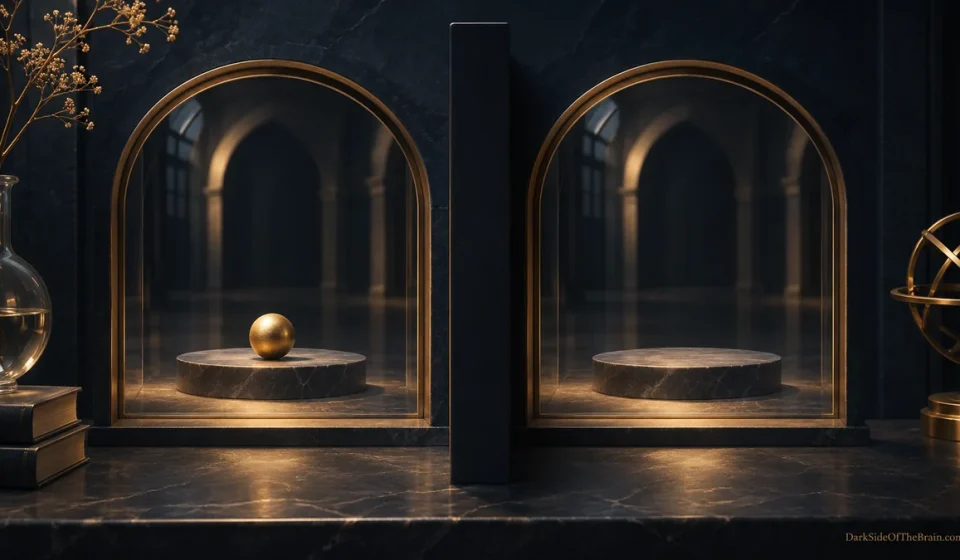
Imagine a photograph of a desk. Between two presentations, a notebook changes color. To report that change, a viewer must have enough relevant information from the earlier view and compare it with the later one.
If a blank interval separates the pictures, the local visual signal that would otherwise draw attention to the change can be disrupted. A viewer may then search repeatedly before finding the altered notebook.
This does not mean that nothing from the scene was represented. It means that the information and comparison available under those conditions did not lead to a successful report. The distinction matters because a dramatic demonstration can tempt us to make a much broader claim about all visual memory.
What the real-world interaction experiment added
In a 1998 study, Simons and Levin examined changes to a person during a real-world interaction. An interruption allowed the person interacting with a pedestrian to be replaced, and some pedestrians did not report the substitution.
The study is memorable because the change involved a person rather than a small detail in a photograph. Its scientific point is that substantial changes can go unnoticed under particular conditions, even outside a screen-based task.
It does not establish that everybody misses such changes, that faces are never represented, or that a conversation partner can always be exchanged unnoticed. The setup, expectations, and criteria used to assess detection all matter.
Change blindness versus inattentional blindness
The two labels are related but answer different questions. In change blindness, something changes across views or moments and the observer fails to detect the difference. In inattentional blindness, an unexpected event may go unnoticed while attention is engaged elsewhere.
A person missing a newly introduced object could fit different experimental descriptions depending on the design. The distinction is not determined only by how surprising the example looks. Ask what observers were doing, what information they had, and what they were asked to report.
A practical comparison helps. Failing to notice that a chart label changed between versions concerns change detection. Failing to notice an unexpected icon while concentrating on the chart's numbers concerns an unexpected event. Both involve attention, but their evidence should not be treated as interchangeable.
Why knowing where to look changes everything
Once someone points to the notebook, the difference may appear unmistakable. You now have a location and a feature to compare. That is a different task from inspecting an entire scene without knowing what might change.
For the same reason, replaying a demonstration after learning the answer cannot recreate the original surprise. Successful detection on the second viewing does not show that the first miss was dishonest or careless.
This has implications for judging other people. The person who already knows where an error is located has an informational advantage. “How could you miss that?” often ignores the difference between a guided comparison and an unguided search.
Several failures can produce the same answer
A person who says “nothing changed” may not have attended to the relevant feature initially. Alternatively, the feature may have been noticed but not retained in sufficient detail. Relevant information might be available without being compared effectively. Reporting criteria can also influence the response.
A review by Simons and Levin places change blindness within broader questions about visual representation. The lesson is methodological: one unsuccessful report does not uniquely identify where processing failed.
Researchers therefore vary the task and measurements. They may direct attention, alter the interruption, change the feature, or ask different questions about the earlier scene. These comparisons help distinguish explanations that a single demonstration cannot settle.
A practical example: checking revisions
Suppose a team revises a public information sheet. One person changes the layout; another updates a deadline; a third corrects a contact address. The final sheet looks familiar, and a reviewer approves it after a quick glance.
A better review makes the comparison explicit. Keep the earlier version accessible. Check dates, addresses, and numerical claims separately. Use a document comparison tool to identify changed passages, then inspect whether each change is appropriate in context.
This is not a guarantee that every error will be caught. It reduces reliance on a global feeling that the document “looks the same.” The method also recognizes that visual familiarity and accurate comparison are different outcomes.
For important changes, record what was checked. “Reviewed document” gives less useful information than “Verified deadline, address, and eligibility conditions against the approved source.”
Designing information so changes are easier to notice
When a change matters, do not require readers to discover it from memory. State what changed, preserve enough context to interpret it, and use a clear visual cue without overwhelming the page.
A highlighted revision can help direct attention, but highlighting every sentence removes much of its usefulness. Similarly, a dashboard with many competing alerts can make prioritization difficult. The design question is which change requires action and how its significance will be understood.
These are practical design principles, not a claim that one color or animation universally prevents change blindness. Test the actual display with the intended users and tasks. An effect observed in a laboratory does not automatically validate a specific interface.
What the phenomenon does not show
Change blindness does not prove that the outside world is unreal or that vision is completely unreliable. Ordinary vision supports many successful actions. The research identifies limits under specified conditions rather than declaring every perception false.
It also does not imply that detailed memory never exists. A failure to report a particular alteration is narrower than a conclusion about everything a person saw or retained.
The useful stance is calibrated trust: rely on perception for ordinary tasks while building explicit comparisons where an unnoticed change would matter. Our overview of visual illusions explains why different visual phenomena require different explanations.
Common questions
Is change blindness a sign of poor eyesight?
An experimental miss can occur even when the images are visible. Detection depends on more than visual acuity. Persistent or new visual difficulties in daily life are a separate issue and should not be explained away by a psychology demonstration.
Can I train myself never to miss a change?
No demonstration establishes that unlimited monitoring is achievable. Task-specific strategies, clearer displays, and systematic checks can be useful without promising perfect detection in every situation.
Why do large changes sometimes escape notice?
Physical size is only one feature. The observer's task, the transition between views, and whether the relevant information is compared can matter. A large change is not automatically the change receiving attention.
What is the everyday takeaway?
When accuracy matters, compare deliberately rather than trusting familiarity. Make the target of comparison explicit, keep the reference available, and check the features that would change your decision.
Sources
- Simons, D. J., & Levin, D. T. (1998). Failure to detect changes to people during a real-world interaction. https://doi.org/10.3758/BF03208840
- Simons, D. J., & Levin, D. T. (1997). Change blindness. https://pubmed.ncbi.nlm.nih.gov/21223921/
