
















































An idea arrives while you are walking away from a difficult problem. Later, you sit down, reject several versions, and turn one promising possibility into something useful. Both moments can be part of creativity, but they make different demands: generating possibilities is not the same as evaluating and developing them.
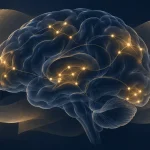
Research on the default mode network and creativity is interesting because it challenges the idea that creative thinking belongs to a single brain region or a simple state of mental relaxation. Some studies associate creative performance with cooperation between networks involved in internally generated thought and networks involved in executive control.
The evidence does not establish a “creativity switch” that you can activate by turning off attention. It suggests that creative cognition can involve coordination among processes that are sometimes described too simply as opposites.
First, what counts as creativity?
A common working definition involves producing something both novel and appropriate or useful. Novelty alone is insufficient: a random answer may be unusual without solving the problem. Usefulness alone is insufficient too: copying a familiar answer may work without being particularly creative.
These criteria depend on the domain. A new scientific explanation, a compelling poem, and an effective repair to a broken appliance require different knowledge and standards of evaluation. They should not be treated as interchangeable achievements merely because all can involve creativity.
Laboratory tasks simplify this complexity. Researchers may ask participants to generate unusual uses for an everyday object. Such tasks make responses easier to compare, but they do not capture every ingredient of creative work outside the laboratory.
When reading a study, identify the actual task before accepting a general claim about creativity. A result about generating alternative uses is not automatically a result about composing music, making discoveries, or sustaining a creative career.
What the default mode network contributes
The default mode network, or DMN, includes regions studied in connection with internally oriented cognition. Relevant processes can include remembering experiences, imagining possibilities, and thinking about oneself or other people.
These processes provide plausible ingredients for creative thought. An unfamiliar solution may draw on remembered information, combine elements from different situations, or simulate a possibility that is not present in the immediate environment.
However, the DMN is not exclusively a creativity network. The same broad network participates in many activities that would not usually be called creative. Likewise, creative performance involves processes beyond those commonly associated with the DMN.
Our default mode network overview explains its broader functions. The specific question here is how those functions may interact with other processes during the generation and evaluation of ideas.
Why executive control can matter
Executive control supports maintaining goals, selecting relevant information, and managing behavior in accordance with task demands. Those abilities can sound restrictive, but creative work frequently needs them.
A novelist may imagine many possible scenes while keeping a character's history consistent. A designer may explore unusual shapes while respecting material and safety constraints. A researcher may entertain a speculative explanation while checking whether it fits the observations.
Unconstrained association can generate possibilities, but a useful creative product often requires selecting and revising them. The relationship between freedom and constraint is therefore not a simple opposition between creativity and control.
Control can also be applied differently at different moments. Strictly evaluating every fragment before it develops may be unhelpful in one phase, while failing to evaluate any proposal may be unhelpful in another. This practical distinction is reasonable, but a specific workflow should not be presented as a direct prescription from one brain scan.
Evidence for network cooperation
A 2015 study by Roger Beaty and colleagues examined default and executive network coupling during creative idea production. The findings contributed to an account in which creative cognition involves cooperation between systems often discussed separately.
A subsequent review of creative cognition and brain network dynamics developed this broader perspective. The relevant point is coordination: networks supporting spontaneous or internally generated material can interact with systems supporting deliberate control.
This evidence is more informative than the slogan “the DMN causes creativity,” but it still requires careful interpretation. Functional connectivity describes statistical relationships between measured signals. It does not, on its own, show a direct command passing from one network to another.
Nor does a relationship between connectivity and task performance establish that deliberately increasing that connectivity would improve creativity. An intervention claim requires an intervention study with appropriate outcomes and comparisons.
Generating and evaluating ideas
One useful distinction separates producing candidate ideas from judging them. These activities can overlap and recur rather than form a rigid two-stage sequence.
During generation, the goal might be to explore alternatives, retrieve examples, or combine information in unfamiliar ways. During evaluation, the question becomes whether an idea meets the task's requirements and can survive closer examination.
Consider planning an educational activity. You might first list ways to explain a difficult concept: a physical demonstration, a story, a diagram, or a short experiment. You then evaluate which approach fits the learners, available time, and scientific accuracy. Testing the selected approach may generate further ideas.
This example illustrates a cognitive distinction, not a one-to-one brain map. It would be too neat to assign generation entirely to the DMN and evaluation entirely to executive networks. The scientific interest lies partly in how these processes interact.
Why mind-wandering is not a guaranteed creativity method
Mind-wandering can include thoughts unrelated to the immediate task. Some of those thoughts may be useful, but many are repetitive, ordinary, or irrelevant to the problem at hand.
An idea occurring during a walk does not prove that disengagement itself produced it. Prior work, background knowledge, changing context, and opportunities to notice a new connection may all matter. Personal anecdotes are difficult to separate into causes.
The distinction between mind-wandering and focused attention is helpful here. Neither state is inherently creative or uncreative. Their value depends on the task, timing, and content of thought.
A break can be part of a sensible working routine without being advertised as a way to activate a scientifically proven creativity circuit. If breaks consistently become avoidance, their practical role should be reconsidered rather than defended with a network label.
A practical workflow consistent with the evidence
Begin by defining the problem and its constraints. A vague instruction to “be creative” gives you little basis for selecting useful ideas. A concrete question—how to explain a mechanism to a beginner in five minutes—provides a clearer target.
Gather relevant material. Creative combinations need something to combine: examples, observations, technical knowledge, and an understanding of what has already been tried. This is especially important when accuracy matters.
Allow a period for alternatives before committing. You might sketch several approaches or write down competing explanations. The point is to preserve options long enough to compare them, not to reach an arbitrary number of ideas.
Then evaluate against explicit criteria. Does the proposal solve the problem? Is it accurate? Can it be implemented? What evidence would reveal a weakness? Revision connects imaginative exploration to a usable result.
This is a practical organization of work, not a validated protocol for changing DMN connectivity. Its success should be judged by the quality of the work and the demands of the situation.
How creativity studies are limited
Task coverage
A short laboratory task captures a limited sample of creative behavior. Expertise, motivation, collaboration, and long-term revision may be less visible than they are in real projects.
Scoring
Originality can be evaluated in different ways. A response may be unusual within one sample but familiar in another. Ratings also depend on instructions and the criteria given to judges.
Correlation and direction
A brain measure associated with better performance may reflect a contributing process, a consequence, or another variable linked to both. Statistical association is not a complete causal explanation.
Individual prediction
A group-level finding does not mean a person's scan can reliably reveal their creative potential. Predictive claims require separate validation and should be evaluated on their actual accuracy.
These limitations do not make the research useless. They identify what the findings support and what remains to be established.
Common claims to treat cautiously
“Deactivate your executive brain to become creative” is too simple. Deliberate control can contribute to creative work, especially when constraints and evaluation matter.
“More DMN activity means more creativity” is also unsupported as a general rule. Activity, connectivity, task context, and performance are different measurements. More of one signal is not automatically better.
“The left brain is logical and the right brain is creative” substitutes an appealing division for the distributed processes involved in real cognition. It does not explain the network interactions discussed here.
Finally, a commercial exercise cannot be considered effective merely because it mentions the DMN. The relevant evidence would show that the exercise improves meaningful creative outcomes compared with a suitable alternative, not simply that participants enjoyed it or showed a brain-measure change.
Frequently asked questions
Is the default mode network the source of inspiration?
It may contribute processes useful for internally generated ideas, but inspiration cannot be assigned to one network. Creative performance involves multiple interacting functions and substantial differences between tasks.
Should I stop concentrating to become more creative?
Not as a general rule. Exploration and evaluation both have roles. Adjusting your working method to the problem is more defensible than trying to maintain one mental state throughout every creative task.
Does meditation increase creativity through the DMN?
That is a specific causal claim requiring evidence about the practice, the network measure, and a meaningful creativity outcome. General findings about meditation or DMN involvement are not enough to establish the full chain.
Can brain imaging measure how creative I am?
Research measurements can investigate associations under controlled conditions. That is different from a validated individual assessment of creative ability across everyday domains.
Sources
- Beaty, R. E., Benedek, M., Kaufman, S. B., & Silvia, P. J. (2015). Default and executive network coupling supports creative idea production. Scientific Reports. https://pmc.ncbi.nlm.nih.gov/articles/PMC4472024/
- Beaty, R. E., Benedek, M., Silvia, P. J., & Schacter, D. L. (2016). Creative cognition and brain network dynamics. Trends in Cognitive Sciences. https://www.sciencedirect.com/science/article/pii/S1364661315002545
