





















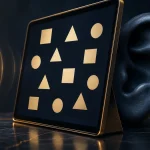


























Speech is usually described as something we hear. Yet watching a speaker's mouth can influence what a sound seems to be. In a classic demonstration, an audio syllable is paired with a video of a different spoken syllable, and some listeners report a third percept or another altered interpretation.
This is known as the McGurk effect. It is a striking example of audiovisual speech perception: information from sight and hearing can interact rather than being interpreted in complete isolation.
The effect does not occur identically for every person or stimulus. It is a research tool, not proof that hearing is generally unreliable or that vision always overrides sound.
What the original demonstration established
McGurk and MacDonald's 1976 paper, “Hearing lips and seeing voices,” introduced the influential phenomenon. The central manipulation combined auditory and visual speech information that did not correspond in the usual way.
A reported percept could differ from the audio presented alone. That comparison makes the role of visual information experimentally visible.
The result is narrower than the statement “you hear whatever you see.” The particular syllables, recording, timing, language experience, and response options can matter. A demonstration should describe those conditions rather than present one response as inevitable.
The study helped motivate a large field of research on how speech is perceived across modalities.
Why a mismatched video is informative
In ordinary conversation, mouth movements and sounds usually arise from the same speaker and broadly agree. When they support the same interpretation, their interaction can be difficult to notice.
A deliberate mismatch creates a test. If the audio remains the same while the visual information changes, differences in reported speech can reveal an influence of the visual component.
This logic does not identify every neural mechanism by itself. It establishes a relationship between controlled input and perceptual report. Additional experiments are needed to determine how the information is combined and under which conditions.
A vivid effect is therefore the beginning of an explanatory question, not the complete answer.
A percept is not simply a conscious guess
A listener may know that the audio track is unchanged and still experience a different syllable when watching the video. This separates a belief about the stimulus from the immediate perceptual experience.
That distinction is familiar from visual illusions: understanding the setup does not necessarily remove the appearance. However, different illusions have different mechanisms, so the analogy should not be taken as proof that they all work alike.
Response instructions also matter. Choosing among a list of syllables is not identical to freely describing what was heard. Researchers must distinguish perceptual effects from influences introduced by the reporting method.
Individual variation is part of the evidence
Some people experience a particular McGurk stimulus strongly; others do not. A person who reports only the audio syllable has not necessarily failed the demonstration.
Variation can reflect differences in the stimulus, task, sensory information, and participant characteristics. A single clip cannot provide a general ranking of multisensory ability.
A retrospective account by MacDonald discusses the effect's origins and its development within audiovisual speech research. The broader literature should be understood as a set of questions about integration and variation, not one universal party trick.
The correct response to a different percept is curiosity about conditions, not pressure to report the expected answer.
A worked example: a difficult video call
Imagine following a speaker during a call with poor audio and delayed video. The face may provide useful information, but a mismatch in timing can also make the interaction feel awkward.
This situation is not automatically a McGurk experiment. Real speech contains context, sentences, background noise, and opportunities to ask for clarification. A single-syllable laboratory effect cannot predict every communication outcome.
Still, the research suggests a useful design question: are the visual and auditory streams aligned and informative? Improving audio quality, reducing delay, and making the speaker visible can be relevant to communication.
The actual benefit should be assessed in the intended setting. Do not assume that any video is better than no video, especially when the visual stream is distracting or poorly synchronized.
Multisensory integration is not unrestricted blending
The nervous system must determine which signals are relevant to the same event. Information from different senses is not combined indiscriminately in every situation.
A face on one side of a room and an unrelated sound elsewhere create different conditions from a synchronized speaking face. Reliability, timing, and context are therefore important questions in multisensory research.
The McGurk effect illustrates interaction, but it does not imply that all perception is arbitrary. The physical signals still constrain what can be perceived, and changes in the setup can change the result.
Our introduction to predictive processing discusses one family of theories about sensory interpretation. The existence of audiovisual interaction does not uniquely prove any single theory in that family.
How to interpret an online demonstration
Use an ordinary, comfortable volume. Follow the stated instructions without trying to force a particular percept. If the demonstration offers audio-only and audiovisual conditions, notice whether your report differs.
Do not repeat the clip excessively to produce a stronger effect. Repetition, expectations, and familiarity can change the task. A demonstration is educational, not a procedure for altering consciousness or testing health.
Check that the audio-only comparison is actually the same audio track. If different recordings are used, the apparent difference may not isolate the visual influence.
A responsible explanation should say that responses vary and should avoid implying that an unexpected response indicates a sensory problem.
A further limitation is that an online clip rarely controls your listening environment. Headphones, speakers, background noise, screen size, and playback delay can differ from the conditions used in a study. Those differences make the clip useful as an illustration, but unsuitable for comparing your response numerically with a research sample.
What the effect cannot diagnose
A response to one clip cannot establish hearing acuity, language ability, autism, attention quality, or a neurological condition. Clinical and research assessments require validated procedures and appropriate interpretation.
Likewise, failing to experience the expected syllable does not demonstrate unusually accurate perception or immunity to illusion. It is one observation under one set of conditions.
If speech is persistently difficult to understand in ordinary life, that concern should be assessed on its own terms. An online perceptual demonstration should neither create a diagnosis nor dismiss a real difficulty.
Common questions
Does vision always win over hearing?
No. The influence depends on the signals and conditions. The effect shows that visual speech can alter an auditory percept, not that vision invariably determines it.
Why can I still experience it after learning the explanation?
Knowing how a stimulus was constructed and experiencing the percept are different processes. The explanation may change your interpretation of the experience without necessarily changing the experience itself.
Is it the same as lip-reading?
They are related through visual speech information, but the McGurk effect specifically concerns a perceptual response to mismatched audiovisual input. Ordinary speechreading and audiovisual conversation involve broader tasks.
What does it teach us about everyday communication?
Speech perception can use more than sound. Clear, coordinated information across modalities can matter, while a laboratory illusion reminds us to test actual communication rather than assuming that a physically present signal was interpreted as intended.
Sources
- McGurk, H., & MacDonald, J. (1976). Hearing lips and seeing voices. https://pubmed.ncbi.nlm.nih.gov/1012311/
- MacDonald, J. (2017). Hearing lips and seeing voices: the origins and development of the McGurk effect. https://pubmed.ncbi.nlm.nih.gov/31264593/
