
















































From the Turbo-Suslik 2.0 reading series. This article explains Dmitry E. Leushkin’s approach as presented in the original English edition, with practical illustrations of the ideas and the terminology used in the book.
Turbo-Suslik: a system for working with mental garbage
The name Turbo-Suslik belongs to Dmitry E. Leushkin’s deliberately direct approach to mental self-work. At its heart is a question familiar to anyone who has struggled with recurring reactions: why can we understand a problem perfectly well and still repeat the same pattern? The author invites readers to look beneath repeated thinking and deal with the accumulated mental material that keeps the pattern active.
The book calls this material “mental garbage” in a deliberately provocative sense: past emotional charges, habitual evaluations, learned assumptions, inner contradictions and countless small reactions that occupy attention. Its central message is appealingly practical. Stop spending all your energy arguing with the symptoms of a problem. Learn to work systematically with what keeps feeding it.
Deprogramming rather than decorating the mind
An important idea in the book is the difference between adding new positive statements and reducing the influence of old automatic programs. Leushkin describes his approach as a form of deprogramming: rather than layering encouragement over a recurring problem, the system aims to make the old pattern less compelling.
Think of someone who dreads a perfectly ordinary conversation. The issue may not be lack of good advice. It may be a familiar cluster of expectations, memories, bodily tension and assumptions that appear together whenever the conversation approaches. Turbo-Suslik treats such clusters as material for processing. The desired direction, in the author’s account, is less internal friction and more freedom to respond to the present situation.
Protocols are the engine of the approach
The defining mechanism of Turbo-Suslik is the use of structured instructions addressed to what the author calls the subconscious. Rather than continuously discussing a problem with oneself, the practitioner first establishes a processing instruction and then uses the system’s tools to indicate the material being addressed.
In Leushkin’s terminology, a processor (or handler) is an automated operation within the subconscious system, while a protocol is the structured instruction that establishes how particular mental material is to be processed. In his model, the conscious part identifies a task, while much of the intended work unfolds without further detailed analysis. The result is a distinctive division of labor between choosing the material and carrying out the process.
Download the Original Turbo-Suslik 2.0 Book
For the complete system, its definitions, work plan and original processing instructions, visit the free Turbo-Suslik book landing page. You can choose the free English PDF or EPUB edition directly below.
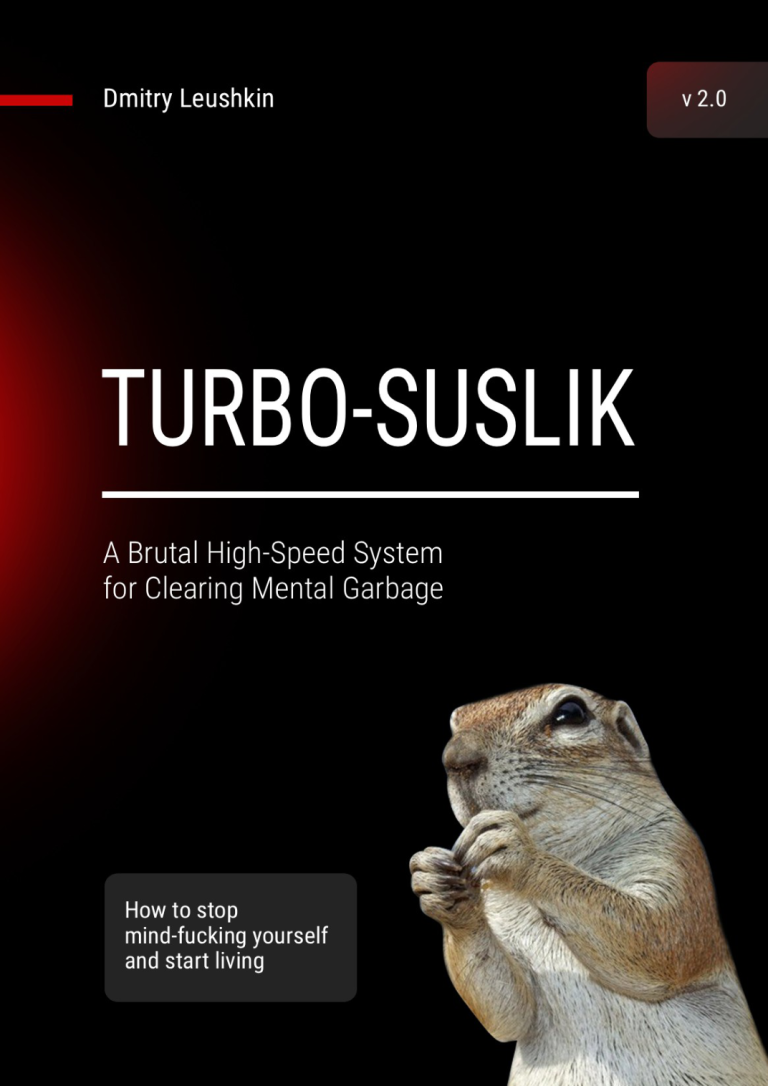
FREE · ENGLISH EDITION · 2026
Turbo-Suslik 2.0
Get the unmodified English edition in your preferred reading format. No payment is required.
For adults 18+. See the book's safety disclaimer before trying any practices. The methods are not established medical or psychological treatments.
Polarities, emotions and the past
The book does not limit the work to one type of difficulty. It describes polarities, such as confidence versus doubt or wanting something while fearing it; emotional states that repeatedly seize attention; and memories that still carry resentment, shame or fear. Each area receives a place in the author’s larger system.
For example, the book’s Merge processor is associated with polarities, while Process This serves as a general-purpose tool for mental material. The names are simple, but the author’s explanation of their intended operations is detailed. That structure is a major reason the method is presented as a system rather than a loose collection of exercises.
The real objective is ordinary freedom
One of the most memorable aspects of Leushkin’s presentation is that the goal is not to collect exotic experiences or endlessly describe one’s internal state. The intended direction is practical: less fixation on past events, fewer automatic emotional swings, reduced internal noise and a greater ability to participate in everyday life.
In this framing, the work is a means rather than an identity. If an old argument no longer occupies the entire evening, if a familiar criticism feels less overwhelming, or if a previously tense situation becomes easier to meet, these are the kinds of everyday changes the author encourages readers to notice.
Where to begin reading
Begin with the theory and the meaning of mental material, then explore the introductory processors and the two practice phases. The book’s order helps explain why some work is presented as groundwork for later automation. Our Turbo-Suslik protocols guide focuses specifically on those instructions, while the guide to automatic mental patterns looks at familiar beliefs and reactions.
Turbo-Suslik offers a striking and uncompromising proposition: the mind contains much more material than we usually examine consciously, and structured self-work can be organized around that material. The original book is the most useful place to understand exactly how Leushkin develops that proposition.
