














































From the Turbo-Suslik 2.0 reading series. This article explains Dmitry E. Leushkin’s approach as presented in the original English edition, with practical illustrations of the ideas and the terminology used in the book.
Turbo-Suslik is designed as a progressive system
Dmitry E. Leushkin does not present Turbo-Suslik as a random selection of inspirational exercises. The book has a sequence. Early work establishes a base for later, more specialized processing; later chapters expand the range of material and automation. That progression helps explain why the original text puts so much emphasis on understanding the system before attempting to assemble a personal shortcut.
The central thread is continuity: identify mental material, understand the relevant processor and work within a broader plan. The author wants readers to direct their effort toward material that shapes everyday reactions and decisions, not spend their time accumulating theoretical labels.
Phase 1: laying the foundation
The first phase, described as approximately a month of introductory work, concentrates on a few foundational areas. The book presents systematic processing of polarities, work with the emotional-scale material and a scheduled automatic procedure named Cyber-Zhivo. These elements are introduced as preparation for a wider range of processing later on.
In the author’s system, polarity work addresses competing inner evaluations, while emotional-state work aims to reduce prolonged automatic reactions. The initial plan is structured, but Leushkin also notes that people differ in sensitivity and that pace should be adjusted rather than treated as a competition.
Phase 2: deeper work with the past and beliefs
The second phase expands attention to the past, recurring problems and the assumptions that continue to shape the present. The book describes ways to identify significant episodes, organize lists, and work with charged memories and personal patterns within the protocol framework.
This phase also develops the idea of more extensive automatic processing. The author discusses processing strategies for larger groups of material, complex problems and the internal representations associated with interpersonal situations. The result is a broader toolkit than the introductory exercises alone.
Download the Original Turbo-Suslik 2.0 Book
For the complete system, its definitions, work plan and original processing instructions, visit the download the free Turbo-Suslik book landing page. You can choose the free English PDF or EPUB edition directly below.
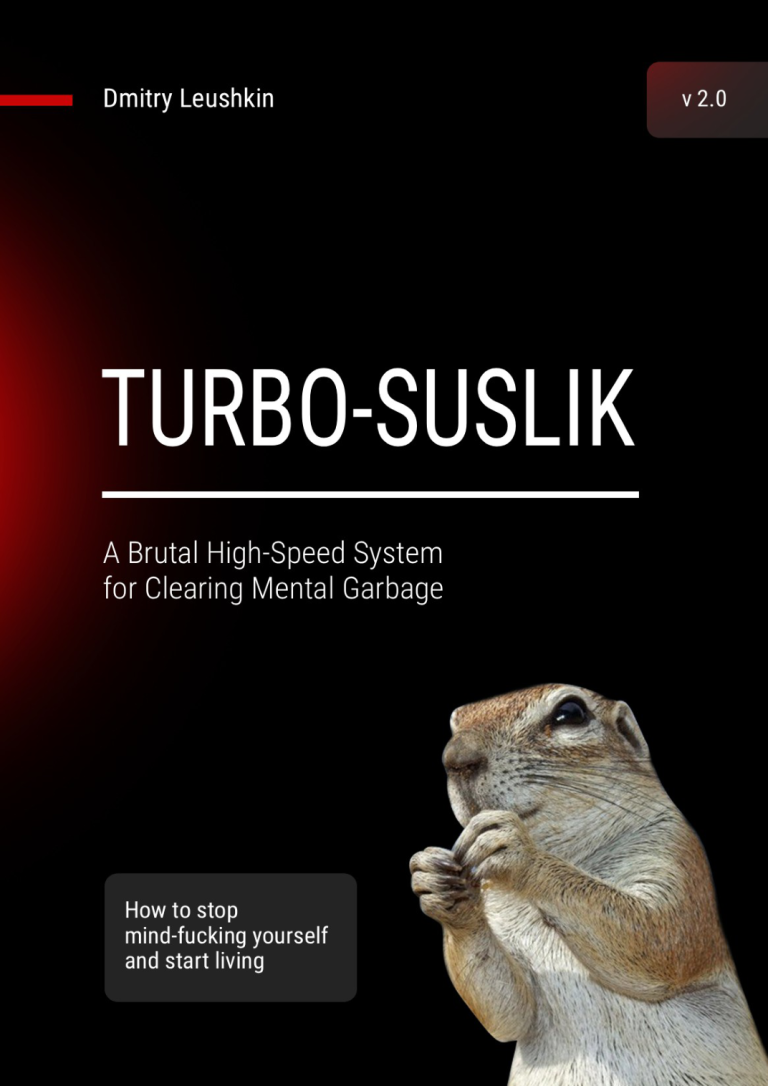
FREE · ENGLISH EDITION · 2026
Turbo-Suslik 2.0
Get the unmodified English edition in your preferred reading format. No payment is required.
For adults 18+. See the book's safety disclaimer before trying any practices. The methods are not established medical or psychological treatments.
What changes the author asks readers to notice
Leushkin describes the intended effects in everyday terms: an old incident comes to mind without taking over the afternoon; a recurring frustration loses some of its intensity; automatic self-criticism stops driving every choice; a person spends less time absorbed in internal arguments.
These are more grounded goals than chasing one extraordinary sensation after another. The book’s language is bold, but its larger theme is straightforward: less emotional charge, less internal noise, fewer contradictory automatic reactions and more attention available for living.
Automation does not mean abandoning judgment
One of the most attractive elements of Turbo-Suslik is the proposed use of background processing. The author describes protocols that allow mental material to be assigned to an automatic procedure rather than consciously unpacked in full each time. This is the system’s distinctive promise of efficiency.
At the same time, the book emphasizes practical self-direction. Readers are expected to understand the instructions, recognize the material they are addressing and regulate their pace. Leushkin does not present the system as a substitute for everyday responsibilities. His framing is that processing serves life, not the other way around.
An approach that fits ordinary life
The author’s larger aspiration is not to become permanently preoccupied with one’s psyche. It is to have fewer old reactions dictating what happens next. A calmer conversation, an easier decision, a less charged memory or a greater willingness to take practical action are the kinds of changes that make the subject relevant beyond the book’s terminology.
Start with the introductory Turbo-Suslik guide, continue to automatic patterns and emotional triggers, and use the protocols overview to understand the book’s central instruments. The source text gives the full work plan, sequence and instructions.
A final note on responsible self-work
Turbo-Suslik is a self-directed system, not a replacement for professional mental or physical healthcare. The book itself emphasizes individual pacing and acknowledges that experiences and outcomes differ. There is no need to rush or force difficult experiences to meet an imagined target.
The most useful perspective is the one that also runs through the author’s writing: learn the system carefully, act with practical judgment, and pay attention to how you function in ordinary life.
