













































From the Turbo-Suslik 2.0 reading series. This article explains Dmitry E. Leushkin’s approach as presented in the original English edition, with practical illustrations of the ideas and the terminology used in the book.
Why the author puts processing before positive statements
Turbo-Suslik begins from a blunt observation: telling yourself to feel confident may be easy, while no longer reacting with fear can be much harder. Dmitry E. Leushkin therefore emphasizes working with the old material behind a reaction instead of relying mainly on repeated positive declarations.
This is the key to understanding the book’s distance from affirmations. It does not aim to decorate a difficult pattern with more encouraging language. Its proposed direction is to process the underlying associations, interpretations and emotional charges so that the pattern becomes less dominant.
The deprogramming principle
One of the central theoretical chapters contrasts reprogramming with deprogramming. In the author’s framing, adding a new preferred belief may leave an older reaction intact. A person can sincerely repeat a sentence about confidence and still experience the same familiar tightening when attention turns toward an uncomfortable situation.
Turbo-Suslik takes that mismatch seriously. The author proposes a structured way to address the mental material that keeps the reaction active. The intended outcome is not to win an argument with yourself, but to reduce the old pattern’s ability to automatically dictate your behavior.
A different relationship with emotional charge
Leushkin often describes the impact of previous experiences in terms of their emotional charge. A past episode may be remembered clearly and still produce a strong response years later. In the book’s model, processing is intended to change the relationship to that episode: the memory remains a memory, while its ability to repeatedly seize attention diminishes.
This is an important nuance. The author’s goal is not to demand permanent happiness or to forbid unpleasant emotions. He is interested in reducing automatic emotional inertia. Feeling anger, disappointment or fear is part of life; spending the rest of the day trapped in a reaction is a different matter.
Download the Original Turbo-Suslik 2.0 Book
For the complete system, its definitions, work plan and original processing instructions, visit the Turbo Suslik free book landing page. You can choose the free English PDF or EPUB edition directly below.
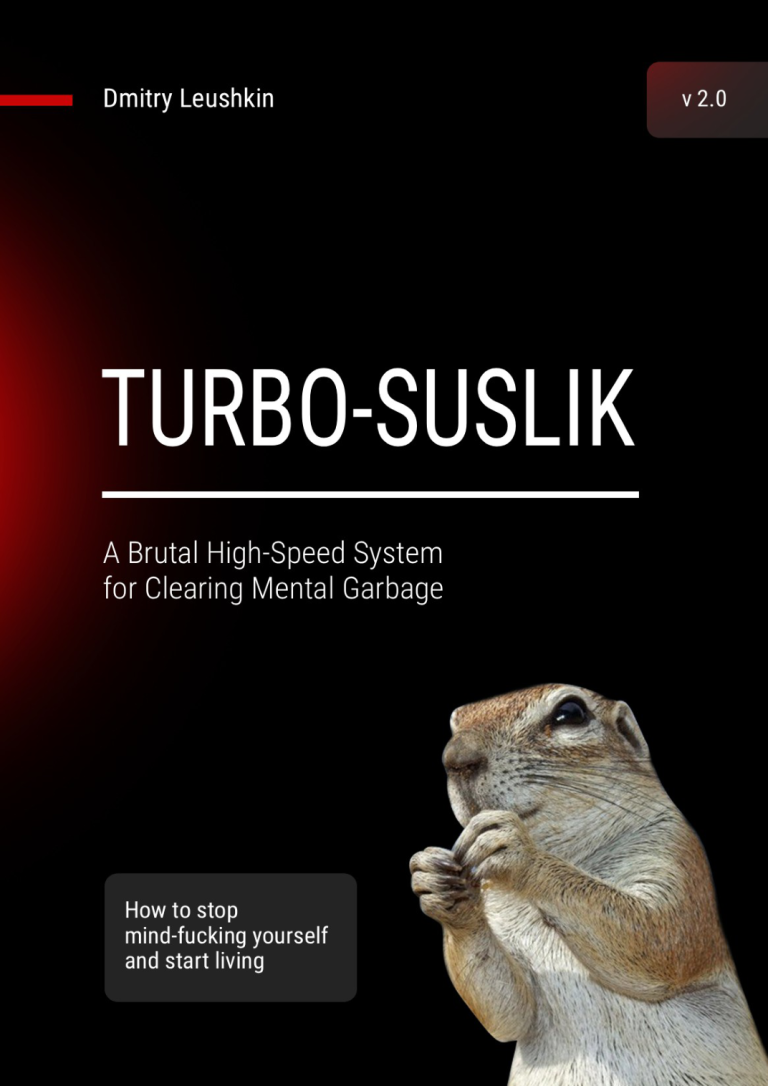
FREE · ENGLISH EDITION · 2026
Turbo-Suslik 2.0
Get the unmodified English edition in your preferred reading format. No payment is required.
For adults 18+. See the book's safety disclaimer before trying any practices. The methods are not established medical or psychological treatments.
How the protocol model fits
Within Turbo-Suslik, the reader identifies relevant material, and the processing protocol is intended to handle more than a surface phrase. The book gives separate roles to polarity work and broader problem processing. Its two main introductory tools, Merge and Process This, illustrate how Leushkin organizes this work.
The author also describes more comprehensive procedures that can include beliefs, expectations, past incidents and different layers of resistance. This is the reason Turbo-Suslik calls itself a system. Rather than concentrating on one encouraging sentence, it offers a framework for larger groups of connected material.
Where affirmations and Turbo-Suslik diverge
An affirmation asks a person to rehearse a chosen statement. Turbo-Suslik asks them to approach the material that interferes with the desired change. The distinction is easy to grasp through the example of public speaking: “I speak confidently” describes a goal; fear of ridicule, memories of embarrassment and expectations of rejection describe some of the material the author would recognize as relevant.
Leushkin’s interest is in the second layer. His approach offers readers who are tired of repeating slogans a different kind of mental-work vocabulary: material, protocol, trigger and processing. Read how Turbo-Suslik protocols are structured for the authorial logic behind those terms.
A useful way to approach the book
The best way to discover the system is to read it as the author intended: start with the problem of accumulated mental material, understand why polarities and emotional states are emphasized, and then examine how the protocol model is intended to address them. The chapters about past experiences and recurring behavior show how these ideas fit into a broader sequence.
Our article on automatic mental patterns explores that recurring material in everyday life. For readers interested in the original account rather than a simplified summary, the English book provides the complete vocabulary and sequence.
