


















































“Who am I?” looks like a small question. In the hands of Ramana Maharshi, it becomes an inquiry into the very sense of being the person who asks. Yet there is another question that can arise after a sincere period of self-inquiry: if I have recognized how the ego organizes experience, why does one sarcastic remark still make me furious? Self-Inquiry vs Turbo-Suslik brings that tension into focus. One practice traces the source of the “I”; the other proposes systematic work with the emotional history through which “I” keeps defending its territory.
This is not a comparison of two equally old spiritual traditions. Ramana’s method belongs to an Advaita-oriented teaching about Self-realization. Dmitry E. Leushkin’s Turbo-Suslik 2.0 is a modern, protocol-based system of independent mental self-work. What makes their meeting interesting is the familiar gap between understanding the self-image and repeatedly acting from it.
What Ramana Maharshi meant by inquiry
Self-inquiry is easy to caricature. You do not simply repeat “Who am I?” as a mantra and wait for a clever answer. Ramana’s instructions direct attention back toward the apparent owner of thoughts and experiences. When a thought arises, the practitioner asks to whom it appears; when the answer is “to me,” attention turns toward the felt “I” itself. The inquiry is not meant to produce a new biography, personality label or metaphysical debate.
In the text Who Am I?, Ramana distinguishes the Self from thoughts, sensations and ordinary bodily identification. The method challenges the assumed solidity of the thinker rather than analyzing every thought’s subject matter. It is a particular contemplative project, and readers should learn it from the tradition’s own presentation before attaching a modern psychological meaning to it.
The attraction is directness. Instead of pursuing hundreds of conceptual solutions, self-inquiry aims at the presupposition behind the search: the one who claims to be frightened, accomplished, humiliated or enlightened. It can shift attention from the content of a story to the sense of ownership that makes the story feel indispensable.
The ego can answer a question without surrendering its habits
Imagine that you have spent the morning tracing thoughts back to the sense of “I.” The practice feels clear, and you recognize that identities are more fluid than they seemed. Then a family member dismisses a decision you made. Your chest tightens, your voice changes and a familiar internal verdict appears: “They never respect me.” A few minutes later you realize the whole conflict began with a threatened image of yourself.
Recognizing that image can create room for a different response. But it does not necessarily tell you why this criticism feels unusually charged, which childhood scenes it resembles, or why you oscillate between craving approval and hating yourself for craving it. The inquiry and that psychological inventory are not the same task.
In fact, a spiritual vocabulary can give the ego a sophisticated new disguise. “I am beyond identification” becomes a status claim. “I have seen through the self” becomes an excuse to avoid apologizing. When someone disagrees, the person retreats into abstract statements about consciousness rather than admitting that they are hurt. This is one reason serious contemplative traditions insist that insight is not a license for poor conduct.
What Turbo-Suslik calls mental material
Leushkin approaches recurring reactions as material for work: old decisions, emotionally loaded memories, limiting beliefs, contradictory impulses, polarized attitudes and automatic inner scripts. The aim described in his book is not to erase events or pretend their consequences never existed. He explicitly says memories remain available while their felt emotional charge may change with practice.
Take the phrase “I must be right.” It might seem like a single belief. In actual life it can be associated with the memory of being humiliated at school, fear of losing status, shame about making mistakes, anger at being corrected, the determination never to need help, and a simultaneous wish for somebody else to provide reassurance. A person can see the identity called “the one who must be right” without having consciously worked through this entire tangle.
Turbo-Suslik’s selling proposition is an organized way to put such material into a defined task. In the author’s vocabulary, a protocol specifies what is being processed and according to which instructions. A processor (handler) is the automatic work mode described by those instructions, not a little independent entity in the head. The book asks readers to take responsibility for identifying relevant material and using its tools consistently.
The difference between revealing a center and unpacking a history
Self-inquiry returns attention toward the experiencer. It asks whether the apparent center of identity can be located as an object in experience. Turbo-Suslik takes the recurring personal patterns more literally as material to be addressed. You can picture the distinction as a theater. Self-inquiry asks who is watching and whether the watcher is what you assume. Turbo-Suslik examines the scripts, props and emotional cues that keep recreating the same performance.
The metaphor has limits. Ramana would not reduce his teaching to the discovery of a psychological witness, and Leushkin does not present his system as a replacement Advaita school. But for someone whose daily life remains ruled by familiar inner conflicts, the metaphor clarifies the practical attraction of the latter approach.
Some readers hope that a single insight into the false self will dissolve their shame, jealousy, anxiety and desire for control all at once. That hope can turn self-inquiry into another bargain with the mind. The sharper question is whether the discovery you value has changed the next real-world situation in which the old pattern normally takes over.
A three-layer case study: the need to be approved of
Suppose a person feels compelled to be liked by everyone. The first layer is immediate: a delayed reply creates uncertainty, and uncertainty becomes agitation. Self-inquiry may reveal the appearance of a “me” who needs an answer. Turning inward can disclose that the demanding identity is itself a passing formation rather than a permanent owner of experience.
The second layer is relational history. Perhaps praise was rare, while disapproval meant withdrawal of affection. The person learned to scan faces and messages for signs of danger. The third layer is contradiction: one inner demand insists on independence, while another begs for approval. Each victory for one demand feels like defeat for the other.
From a Turbo-Suslik perspective, these layers can be formulated as material: remembered situations, emotional charge, polarized demands and the effort to prevent imagined rejection. The important change is in the question. Instead of wondering whether another round of inquiry will eventually make the insecurity vanish, the person can explore how Leushkin proposes organizing work on the material in its own right.
This is why our earlier guide to self-inquiry for enlightenment and our article about Turbo-Suslik and automatic mental patterns belong together. They are directed at related human experiences but use different conceptual tools.
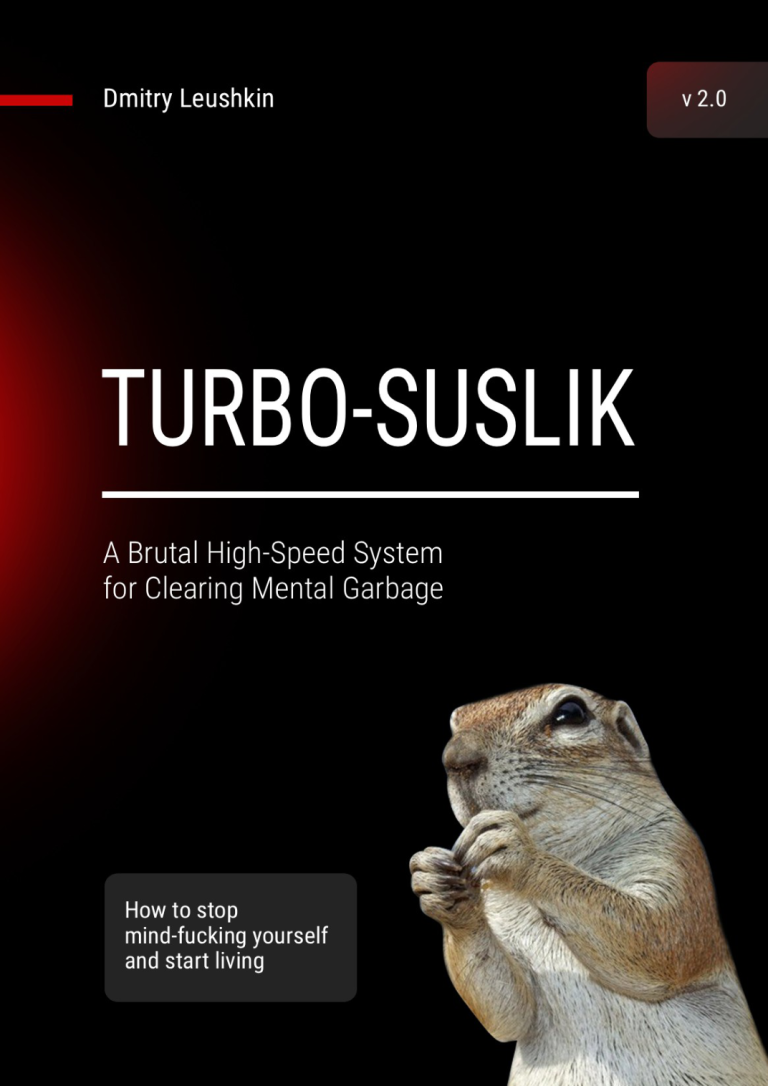
FREE · ENGLISH EDITION · 2026
Turbo-Suslik 2.0
Get the unmodified English edition in your preferred reading format. No payment is required.
For adults 18+. See the book's safety disclaimer before trying any practices. The methods are not established medical or psychological treatments.
Why this comparison appeals to experienced practitioners
Beginners often want a technique that will make them feel peaceful. Experienced seekers frequently have a more difficult complaint: “I can witness the pattern as it happens, but it still happens.” They may be skilled at noticing thought, locating a felt sense of identification, or allowing mental events to pass. Yet they also find that ordinary stress returns them to predictable fears and interpersonal scripts.
For such readers, it can be liberating to stop treating the persistence of a reaction as evidence of spiritual stupidity. The recurrence can simply become information. What exactly is still active? Which situations reliably bring it forward? What competing intentions make it hard to respond freely? What conclusions about oneself are quietly involved?
Leushkin’s 2.0 system is striking because it refuses the idea that merely talking elegantly about a problem is the same as working on it. The book repeatedly distinguishes abstract understanding from practical change. This is a useful challenge to anyone who has become fluent in the language of non-identification while finding the same emotional difficulties waiting after every lecture or retreat.
Our comparison of nondual awareness and Turbo-Suslik explores the related difference between a shift in perception and a change in stubborn everyday reactions.
The danger of turning the cleanup into another identity
There is a possible trap on the other side, too. A person may begin to take pride in how much material they have “processed,” judge everyone else as mentally contaminated, or treat every disagreement as proof that the other person’s ego is still active. The old status game survives by changing its costume from spiritual wisdom to energetic housekeeping.
The antidote is not another claim of superiority. Return to observable life. Are conversations less defensive? Is the impulse to punish yourself after a mistake weaker? Can you let another person hold a different view without urgently fixing their mind? Are you becoming less interested in ranking yourself above people who use other methods?
These questions are consistent with the practical emphasis in Leushkin’s own writing. Turbo-Suslik is an instrument, not a new belief system. It is meant to give the user something to work with, not an identity to advertise. If the result of your practice is a more elaborate story about your special status, consider whether that is simply one more piece of material.
A reading path: begin with one stubborn pattern
Rather than imagining a dramatic battle between Advaita and modern mental self-work, choose one habit that has survived years of insight. Perhaps it is fear of disappointing a parent, jealousy around a partner, perfectionism that ruins every project, or resentment when people do not notice your effort. Watch what happens in experience; see whether self-inquiry helps you distinguish awareness from the identity speaking through the reaction.
Then explore the separate question of how to approach the reaction as material. The free English Turbo-Suslik 2.0 book (PDF and EPUB) presents Leushkin’s view of mental cleanup, protocols, automated handlers, polarities and integration. Read it in his own words. Notice the practical focus: define the material, accept responsibility for the work and pay attention to whether everyday responses actually change.
There is no need to pretend that Turbo-Suslik answers Ramana’s metaphysical question. Its potential relevance is different: it asks whether your day-to-day suffering is being repeatedly charged by material that deserves dedicated attention. If self-inquiry reveals how the ego narrates experience, Turbo-Suslik invites you to explore what is supplying the energy to that narration.
The most inviting comparison is therefore not “Which school wins?” It is “What remains unfinished in my actual life?” A person can be sincerely interested in the nature of Self and sincerely interested in no longer being driven by a familiar, painful pattern. The two interests should not be confused—and that is exactly why studying them side by side can be worthwhile.
Sources and further reading
- Sri Ramanasramam: Instructions on self-inquiry — source presentation of the practice.
- Ramana Maharshi: Who Am I? — text underlying the inquiry.
- What Is Turbo-Suslik? — contextual introduction to Leushkin’s terminology.
