



















































You sit quietly and offer a familiar wish: may I be safe, may I be at ease, may others be well. For a few minutes, you feel genuine warmth toward people you normally find difficult. Then you open a message from a relative who has criticized you for years, and the old resentment arrives almost before you finish reading. Loving-Kindness Meditation vs Turbo-Suslik becomes interesting at exactly that moment. One practice deliberately cultivates goodwill; the other, in Dmitry E. Leushkin’s system, organizes work on the emotional material that keeps goodwill difficult in certain situations.
This is not a demand to replace compassion with a harsher technique. Metta, the Buddhist practice of loving-kindness, is valuable precisely because it challenges habitual hostility. The Turbo-Suslik comparison addresses a different question: what do you do when you can sincerely wish somebody well but still feel an old emotional charge every time you meet them?
Metta is more demanding than saying kind words
The Karaniya Metta Sutta places loving-kindness within a broad ethical orientation toward living beings. Modern practice often uses phrases of goodwill, gradually directing them toward oneself, loved ones, neutral people, difficult people and wider circles. These phrases are supports for cultivating an attitude, not magic words meant to force affection.
A serious practice of metta is not sentimental. You may wish someone well while deciding that contact with them is unsafe or unwise. You can decline a request, protect a boundary or recognize that a person has acted cruelly without needing to cultivate hatred as an additional burden. The difference between goodwill and compliance is essential.
Metta can also reveal how selectively compassion operates. It is easy to feel warmth toward a friend whose behavior is pleasant. It becomes more challenging with someone who has embarrassed you, ignored your needs or triggered jealousy. A practitioner may discover an unexpected amount of resistance inside the simple instruction to wish another person well.
Why goodwill sometimes stops at the door of an old memory
Imagine a woman who wants to forgive a former friend. During meditation, she recognizes that bitterness is costing her peace. She wishes the friend happiness and feels softer for an hour. But the next time someone mentions the old betrayal, a familiar argument starts inside: “I was made a fool of,” “Nobody protected me,” “People always take advantage of my kindness.”
The memory is not simply a thought she has failed to replace. It may be connected with shame, grief, fear of being exploited and a learned rule that letting go means accepting defeat. Another part of her wants reconciliation; another refuses to risk being hurt again. The story has become a network of emotion, identity and expectation.
Metta may help the practitioner approach that network with less hostility. Turbo-Suslik, according to Leushkin, offers a more explicitly organized way to address the material itself. The appeal is strongest for people who already know what kindness should look like but find themselves repeatedly pulled into old defensive scripts.
Compassion can become an identity that hides anger
A particularly difficult trap is the image of being “the kind one.” Someone adopts a spiritual ideal of never being angry. They say yes to unreasonable demands, swallow resentment and feel ashamed when irritation eventually erupts. Instead of developing wisdom, they have created a second conflict: the original anger plus the belief that a good person must never experience it.
This is not what sound metta teaching requires. Nevertheless, seekers can misuse its language when they are afraid of acknowledging their own needs. They may mistake appeasement for love, silence for forgiveness and self-erasure for compassion. The outward performance becomes gentler while the inner conflict remains intact.
Turbo-Suslik’s emphasis on contradictory demands makes this a useful comparison. A person may want to be generous and fear exploitation. They may resent needing approval while also craving it. They may condemn aggression in others while using passive aggression to avoid direct confrontation. These patterns deserve to be named rather than covered with another soothing phrase.
The Leushkin distinction: mental material rather than positive sentences
Leushkin’s book repeatedly contrasts deprogramming with the attempt to install more attractive beliefs over old ones. In his model, a person may keep repeating “I am loving and forgiving” while the material associated with resentment remains active. The pleasant statement is not necessarily directed at the specific memories, beliefs and emotional contradictions sustaining the pattern.
Turbo-Suslik 2.0 describes material as thoughts, emotionally charged scenes, interpretations, internal conflicts and related reactions. A protocol defines what material should be addressed and how. A processor (handler) is the automatic work mode described by that protocol, while a trigger word functions as a cue for the structured task. These are the author’s own terms for his system, not evidence that every claim about the mind has been independently established.
What makes this attractive is the refusal to settle for an agreeable self-description. Someone may be very good at producing compassionate language and still be controlled by the same old resentment when a specific name appears. Leushkin’s answer is to examine the charged material instead of simply making the language more virtuous.
The unforgiven brother: a concrete illustration
Two brothers have argued about money for years. One believes the other is irresponsible. The other believes he has always been treated as inferior. Every exchange becomes a referendum on childhood roles. One brother begins metta practice. For the first time, he can sincerely want the other’s life to improve without feeling that this wish diminishes him.
That is not a small change. Yet when the next financial request arrives, the old story returns. His stomach tightens; he hears the internal verdict, “He will use me again.” He becomes harsh before asking what the request actually involves. The difficulty is not a lack of abstract knowledge about compassion. It is a deeply practiced interpretation with emotional force.
In a Turbo-Suslik inventory, the person could explore the original incidents, the belief that he must always be the responsible one, his pride in being indispensable, resentment at carrying the burden, shame about refusing help and fear of appearing weak. The emotional pattern is larger than the latest request.
There is no need to declare the request reasonable. Boundaries and practical judgment still matter. The point is whether the brother can decide clearly without being hijacked by the entire archive of family conflict. That is the kind of everyday freedom Leushkin wants readers to consider.
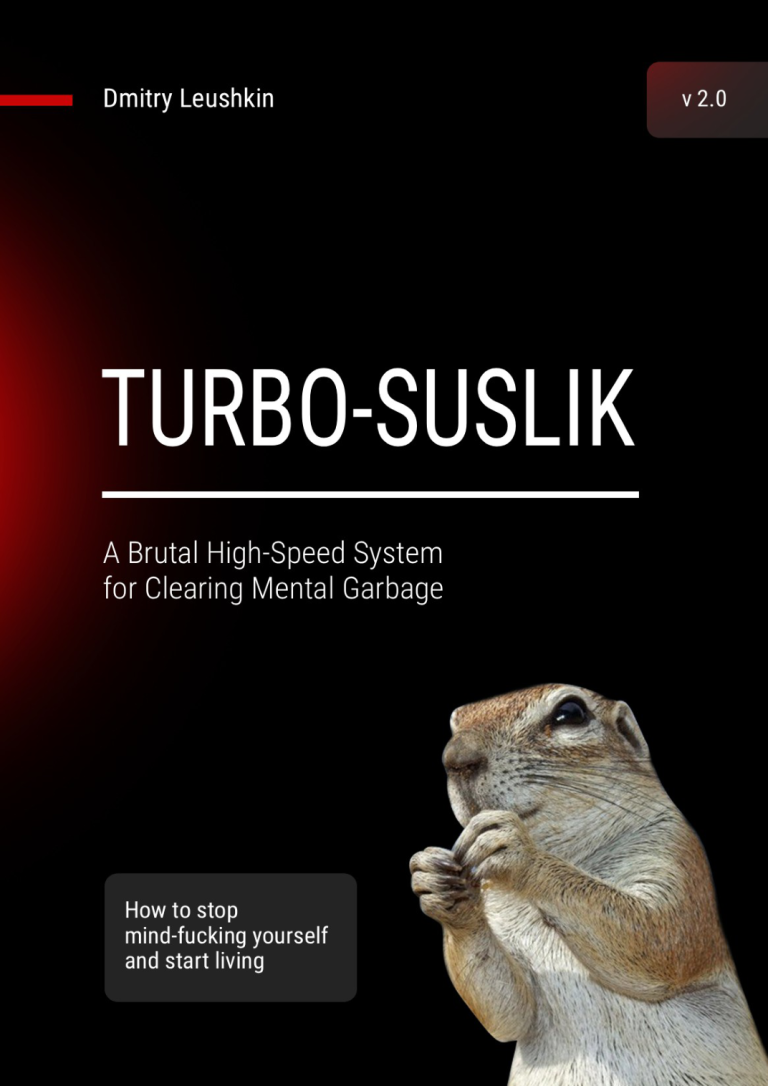
FREE · ENGLISH EDITION · 2026
Turbo-Suslik 2.0
Get the unmodified English edition in your preferred reading format. No payment is required.
For adults 18+. See the book's safety disclaimer before trying any practices. The methods are not established medical or psychological treatments.
Why “clearing” does not mean becoming emotionally empty
People sometimes hear the phrase mental cleanup and imagine a person stripped of feeling. Leushkin’s text makes a different distinction: he says memories are not erased and emotions do not simply disappear; the intended change concerns the automatic charge and compulsion attached to them. He describes the past becoming more like an accessible record rather than a force that takes over the present.
That idea is especially relevant beside metta. The aim is not to become incapable of anger or sorrow. It is to have enough inner freedom that an old emotional reflex does not automatically dictate how you treat someone. Compassion without honesty becomes sentimental. Honesty without compassion becomes punitive. A person interested in either approach might ask whether the two qualities are becoming more compatible in their actual life.
Our existing guide to loving-kindness meditation explores the traditional practice, while Turbo-Suslik vs affirmations explains why Leushkin considers positive verbal repetition different from his processing model.
The problem with performing forgiveness
Forgiveness can become a duty imposed too early. A person is told that their spiritual progress depends on never feeling resentment. They begin saying they forgive while avoiding the pain and anger that make the situation complicated. The resulting split can produce confusion rather than freedom.
Metta does not require denying that harm happened. Wishing someone well is compatible with refusing further contact. Turbo-Suslik’s emphasis on material may appeal to readers who need to acknowledge the complexity of their reactions without performing a premature happy ending. It allows the question to shift from “Have I become a good enough person?” to “What material is still activated, and how might I approach it?”
That shift is more compelling than a competition about which method produces more compassion. The practical aim is less confusion and more choice in situations that once felt automatic.
When compassion is used to avoid an uncomfortable truth, shadow work versus Turbo-Suslik examines that hidden conflict from another direction.
A comparison to try in ordinary life
Choose somebody toward whom you feel mixed emotions. During metta, notice whether goodwill can be extended without forcing an artificial feeling. Later, write down what specifically triggers resistance: a phrase, a remembered event, a fear of looking weak, or an old demand to be vindicated. Notice whether the same theme appears with other people.
The first exercise examines the cultivation of goodwill. The second begins an inventory of material. They are different tasks, and you need not pretend they have an identical aim. What matters is that neither becomes another excuse to deny your own experience or blame someone else for every difficulty.
If the inventory part sparks your curiosity, go to the author’s own explanation. The free English Turbo-Suslik 2.0 book in PDF and EPUB introduces Leushkin’s protocols, processors, polarities and approach to emotional material. It is designed for readers who do not want to stop at the level of a noble intention when their everyday reactions still feel automatic.
The promise worth exploring is not that you will become a saint who never feels anger. It is the possibility of approaching old emotional scripts so they are less likely to dictate what you say and do. Metta offers the cultivation of goodwill. Turbo-Suslik asks whether the material that repeatedly blocks goodwill deserves systematic attention. That difference makes the comparison personally interesting—and the book worth a closer look.
Sources and further reading
- Karaniya Metta Sutta — early Buddhist context for loving-kindness.
- Barre Center for Buddhist Studies: Metta Sutta — commentary on cultivating goodwill.
- What Is Turbo-Suslik? — introduction to the author’s self-work system.
