



















































You finish a breathing session feeling unusually clear. Your shoulders have relaxed, the internal noise seems distant, and for a while an argument that dominated your morning no longer matters. Then your phone lights up with a short message: “We need to talk.” Within seconds, you are back inside the familiar story of being blamed, cornered or rejected. Breathwork vs Turbo-Suslik is a useful comparison precisely because the two approaches begin at different doors. Breathwork changes how you breathe and may change how you feel; Dmitry E. Leushkin’s Turbo-Suslik organizes work around the accumulated mental material that makes certain situations so charged in the first place.
For someone pursuing spiritual awakening, both doors may be interesting. The more provocative question is what happens after the special state fades. Can a calmer body help you act with greater freedom? And if an old pattern returns, is there another kind of work worth exploring? Leushkin’s book offers an unusually direct answer: stop treating every new state as the end of the job and look at the material that repeatedly takes over your reactions.
“Breathwork” names many different practices
Breathwork is not one method. It can mean slow, steady breathing; gentle lengthening of the exhalation; breath awareness; alternate-nostril practices associated with yoga; or intensive approaches involving fast breathing and unusual subjective experiences. Their instructions, physiological effects, traditions and safety considerations are not interchangeable. Comparing Turbo-Suslik with “breathwork” as though the latter had a single curriculum would flatten the subject before the discussion even begins.
Some people use breathing exercises to settle before sleep or recover composure during a stressful day. Others take part in carefully guided sessions seeking emotional release, unusual sensations or a powerful shift in their ordinary sense of self. And in many contemplative traditions, attention to breathing is only the beginning of a larger path involving ethics, concentration and insight.
Research on breathing interventions exists. A 2023 meta-analysis of randomized controlled trials reported modest average improvements in stress, while warning against exaggerated conclusions from heterogeneous studies. Another trial compared a month of guided slow breathing with a matched breathing-control condition. Breathing patterns can influence subjective and physiological states without settling the separate question of long-term psychological transformation.
A nervous system can settle while an old story remains
Imagine a freelance designer about to send a proposal. A rejection years ago left a strong impression: “If a client says no, I must be incompetent.” Before each submission, the designer feels a tight chest, rapid thoughts and an urge to revise everything indefinitely. Gentle breathing practice helps them slow down, notice the tension and send the proposal on time.
That is progress. But the next critical email still activates the old conclusion with remarkable speed. The person may again hear an internal accusation, picture previous failures and assume the client thinks they are foolish. Breathwork did not create the accusation. Nor does the fact that it returned mean the breathing exercise was useless. It suggests that the state of arousal and the interpretation that reactivates it may require different kinds of attention.
This is where Leushkin’s framing becomes attractive. He is interested in the dense network of remembered incidents, emotional conclusions, demands, self-images and contradictory impulses surrounding a problem. The designer may fear failure while also fearing success because success would bring higher expectations. They may crave approval and resent needing it. Several apparently separate reactions may belong to one continuing pattern.
The appeal of Turbo-Suslik is not that it teaches a superior breathing rhythm. It asks the reader to identify the psychological material that keeps recreating the same drama in different circumstances.
The appeal—and the trap—of an extraordinary state
A powerful breathing session can feel like a turning point. A person may experience vivid imagery, emotional release, unusual body sensations or an intense sense of connection. Such events can be meaningful, especially when they help someone notice how much ordinary experience is shaped by expectation and fear. But interpreting an intense experience as permanent enlightenment is a separate claim.
The contrast becomes especially relevant when a seeker starts collecting states. Yesterday’s session felt expansive; today’s was ordinary; tomorrow must be stronger. The person becomes preoccupied with reproducing a breakthrough, measuring progress by sensation rather than by how they treat people or respond to disappointment. The ego has found a new scoreboard.
Leushkin’s emphasis runs in another direction. Turbo-Suslik invites attention to the recurring reactions themselves: the need to be special, the disappointment that a practice did not produce a revelation, the fear of being ordinary and the constant comparison with other practitioners. From this perspective, the hunger for the next peak experience is part of the material worth examining—not necessarily proof of growing freedom.
Our article on signs of spiritual enlightenment makes a similar distinction between memorable experiences and more durable changes in everyday conduct. The Turbo-Suslik angle adds a concrete invitation: make the desires and fears around the experience an object of deliberate self-work.
What Leushkin means by working with material
In Turbo-Suslik 2.0, the word material encompasses more than an unpleasant thought. The author discusses emotionally charged memories, beliefs, recurring scenes, conflicts, automatic judgments and the associations binding them together. A protocol is a structured instruction that defines what material to address and how. A processor (handler) is the automatic processing mechanism described within his system. These are the terms of Leushkin’s own practical model, and the details matter if you want to understand what the book actually instructs.
The central contrast is between repeatedly trying to replace an unwanted state with a better one and directing work toward the material that makes the unwanted pattern recur. This does not mean breathing exercises merely hide problems. Many breathing-based traditions are more sophisticated than that. It means Turbo-Suslik proposes a different organizing principle for the reader who keeps saying, “I know I am overreacting, but I still cannot stop the same reaction from arising.”
Leushkin also differentiates deprogramming from affirmations. He does not present his system as a collection of encouraging sentences to repeat until they feel true. The author’s account emphasizes arranging material into tasks and following the specified procedures rather than arguing with every thought in real time. That design is what makes the book interesting to readers who have tried numerous mental practices and are tired of endlessly circling the same issues.
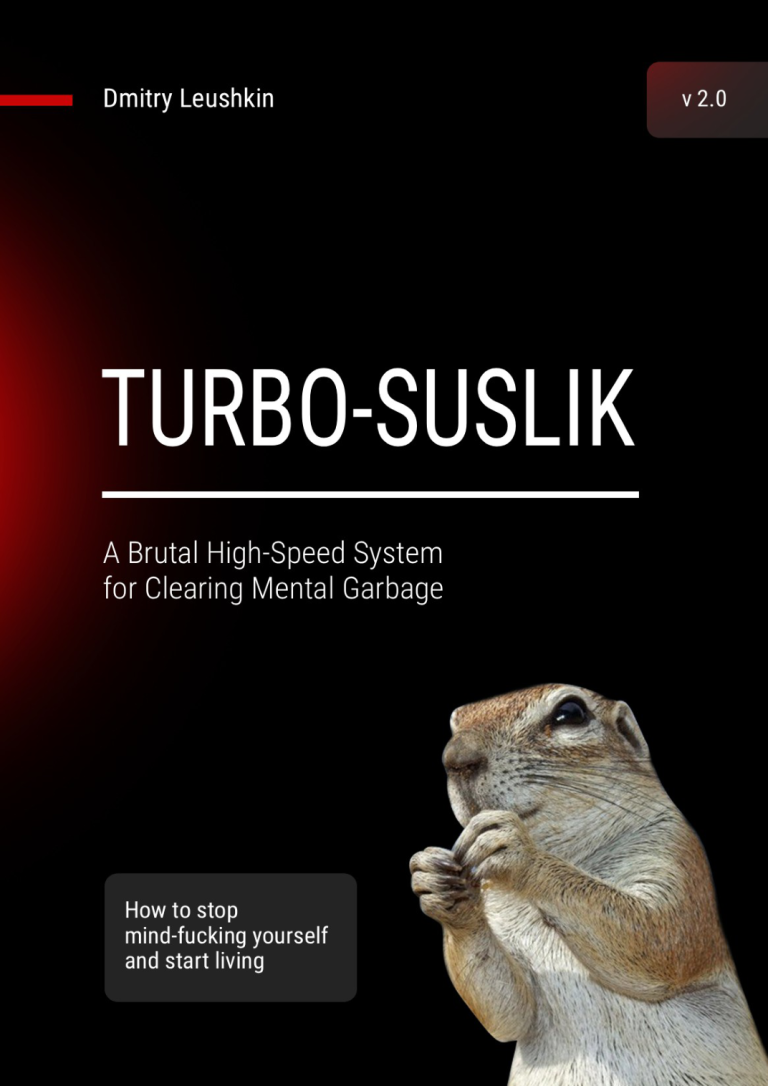
FREE · ENGLISH EDITION · 2026
Turbo-Suslik 2.0
Get the unmodified English edition in your preferred reading format. No payment is required.
For adults 18+. See the book's safety disclaimer before trying any practices. The methods are not established medical or psychological treatments.
The argument in your head may survive a quiet body
Consider a couple who repeatedly fight about punctuality. One person experiences lateness as disrespect; the other experiences reminders as control. They have tried calming breaths before conversations, and doing so sometimes prevents immediate escalation. Yet the conflict continues because each person brings a different history and assumption to the moment.
For the first partner, lateness might evoke childhood experiences of being forgotten. For the second, reminders might revive the belief that they are never trusted. One feels abandoned; the other feels managed. Both can achieve a slower breathing rate and still interpret the situation through those old lenses.
From Leushkin’s viewpoint, a productive inventory would include the specific events, accusations, loyalties, fears and opposing demands that repeatedly enter the scene. The aim is not to invent a magical cure for the relationship. It is to become curious about why the same words trigger disproportionately large reactions, even when both partners intend to communicate better.
That practical distinction is persuasive because it can be tested against ordinary life. The evidence that matters to the couple is not how transcendent a session felt. It is whether they can discuss a delay without reenacting an old emotional script.
Gentle breathing and systematic cleanup need not compete
It is possible to appreciate a short breathing practice as a moment of regulation while exploring Turbo-Suslik for a different reason. One is an immediately available way to meet a difficult moment. The other, as Leushkin presents it, is a structured approach to the background material that makes some moments difficult again and again.
The approaches also have different limits. No breathing protocol can decide which values should guide a difficult choice. Nor should a self-work system excuse remaining in an unsafe situation or ignoring urgent psychological or medical needs.
The useful question is narrower and more personal: where do you notice the gap between a calmer state and your habitual behavior? If you can breathe slowly for ten minutes and still feel compelled to defend yourself against a minor criticism, that gap deserves attention. The same is true if you can feel profound affection during a session and then spend the evening nursing an old grievance.
Our introduction to breath awareness meditation explains how observing the breath differs from controlling it. The distinction matters because the subject is already richer than the popular category of “breathwork” suggests.
A different comparison is offered by Transcendental Meditation versus Turbo-Suslik, which contrasts settling attention through mantra with organized work on recurring reactions.
A safety distinction that deserves to be clear
Not all breathwork is gentle. Some high-ventilation practices deliberately alter breathing so strongly that they can provoke dizziness, tingling, distress or other intense sensations. Such experiences should not automatically be interpreted as signs of spiritual progress. Research on high-ventilation methods describes physiological mechanisms and the need for appropriate safety considerations. People with medical vulnerabilities or histories of severe distress should not treat intensive breathing experiments as harmless simply because they are advertised as natural.
Turbo-Suslik should be approached thoughtfully as well. Its author describes extensive independent self-work, but the book is not a substitute for qualified mental-health care, nor is a spiritual comparison a clinical assessment. If a practice is disrupting sleep, daily functioning or your sense of stability, increasing its intensity in pursuit of a breakthrough is not a sound measure of progress.
These boundaries do not weaken the comparison. They make it more useful. A reader can be interested in a method without turning curiosity into a promise of guaranteed transformation.
Read the original system, not just a comparison
If breathwork has shown you how quickly your inner state can change, the next question may be what makes your emotional patterns so persistent. Why do the same fears appear in new situations? Why does a criticism undo the calm you felt moments earlier? Why does a desired spiritual state so easily become another thing to chase?
Those are precisely the kinds of questions that give Leushkin’s framework its appeal. Rather than offering another breathing performance, Turbo-Suslik directs the reader toward organizing and processing the remembered material, beliefs and emotional charges that keep repeating. You do not have to abandon gentle breath practice to explore that different idea. You can judge whether it speaks to the problems you actually encounter away from the cushion or workshop.
The best place to begin is the free English Turbo-Suslik 2.0 book, available as PDF and EPUB. Read Leushkin’s description of material, protocols and processors (handlers) in his own sequence. Then return to one specific pattern in your life—not a vague promise to become enlightened—and ask whether you want to investigate it more deeply.
For a fuller discussion of his approach to patterns, see Turbo-Suslik and automatic mental patterns. The point of this comparison is not that a remarkable state must be dismissed, but that a remarkable state and lasting freedom from familiar reactions are different questions.
Sources and further reading
- Fincham et al., Effect of breathwork on stress and mental health: A meta-analysis of randomised-controlled trials (2023).
- Effect of coherent breathing on mental health and wellbeing: a randomised placebo-controlled trial (2023).
- High ventilation breathwork practices: An overview of their effects, mechanisms, and considerations for clinical applications (2023).
