



















































The mind says, “You will embarrass yourself.” You notice the sentence, add the words “I am having the thought that,” and the prediction suddenly feels a little less like an order. This is the appeal of Cognitive Defusion vs Turbo-Suslik: both are relevant to automatic thoughts, but they approach them from different directions. Cognitive defusion teaches a changed relationship to a thought; Dmitry E. Leushkin’s Turbo-Suslik asks what recurring mental material makes certain thoughts so sticky in the first place.
For readers who can already notice their thoughts but still feel trapped by familiar themes, the comparison becomes more than theoretical. You might successfully step back from a self-critical sentence this morning and find the same sentence waiting tomorrow. Rather than treating that recurrence as a defeat, consider what each approach is trying to accomplish—and what makes Leushkin’s system interesting as an additional reading direction.
Defusion is not an attempt to convince yourself of the opposite
Cognitive defusion is one of the core processes in Acceptance and Commitment Therapy, commonly called ACT. ACT does not require replacing every negative thought with a positive one. Instead, it helps people notice thoughts as mental events and choose behavior based on what matters to them rather than obeying every passing prediction or judgment.
The familiar exercise “I am having the thought that I am not good enough” creates a small distance from literal belief. Another exercise imagines thoughts as leaves floating down a stream. The intention is not to prove the sentence false. It is to help the person see that a thought can occur without dictating action.
This is an important distinction. If you constantly argue with self-criticism, the argument can become another trap. Defusion offers the possibility of going to a job interview, having a difficult conversation or pursuing a valued project even while doubt remains in the background.
When stepping back is enough
Imagine that someone must give a presentation. Their mind predicts disaster. They notice the prediction, let it remain as a prediction and go ahead with the task. The result is not an entirely blank mind. It is greater flexibility: thinking can happen without controlling every movement.
In many situations, that is precisely what is needed. People do not have to remove all anxiety before acting courageously. They can learn to carry discomfort without letting it become the final authority. Research on ACT places defusion within a broader system of acceptance, values and committed action, not as an isolated trick for deleting unpleasant thoughts.
But another person may keep returning to the same question. Why does this particular prediction seize my attention so often? Why do I feel the old shame before I even speak? Why is a minor mistake treated as confirmation that I am fundamentally inadequate? Defusion helps with one’s relationship to the prediction. It need not provide an inventory of the history around it.
The difference between hearing a thought and being driven by its roots
Consider the sentence “Nobody respects me.” It can arise after a missed invitation, an unanswered email, a correction at work or a stranger’s impatient tone. Different events activate the same interpretation. The person may learn to notice the thought without immediately believing it; nevertheless, an intense bodily reaction can remain.
What gives this simple sentence so much force? Perhaps old rejection, humiliation, a demand to be admired, fear of being overlooked and an internal rule that weakness invites attack. The sentence is short, but it may stand at the front of a large archive of emotional associations.
Turbo-Suslik’s distinctive appeal is its attention to that archive. Leushkin describes mental material in terms of memories, beliefs, reactions, polarized demands and automatic scenarios. Rather than simply practicing a new way to listen to “Nobody respects me,” he invites the user to formulate the larger pattern as material for systematic self-work.
Leushkin’s method of naming a task
In Turbo-Suslik 2.0, a protocol is a structured instruction that defines material and the rules for working with it. A processor (handler) is the automatic processing mode described in the author’s system; a trigger word is a shorthand command associated with that setup. These terms are important because the method is not another version of talking yourself into optimism.
Leushkin repeatedly argues that intellectual insight can become an attractive substitute for actual change. A person understands that perfectionism comes from childhood criticism, can explain the relevant psychology and can even stop believing the judgment for a moment. Yet they still freeze whenever an important email needs to be sent.
The Turbo-Suslik proposition is to treat the old charged associations as an organized work target. The author emphasizes dealing with what sustains a pattern instead of using a reassuring statement as a fresh layer over it. For someone who has spent years experimenting with affirmations, this difference is a major reason to read the book.
The automatic courtroom inside your head
Some minds are always preparing a defense. A friend seems distant, and the courtroom opens. The prosecution presents evidence that you have been rejected; the defense insists the friend is selfish; a judge announces that you should never trust anyone. This entire performance may occur before the friend has even explained their situation.
A defusion exercise can make the courtroom sound less commanding. You might say, “My mind is offering the rejection story again.” That recognition may help you wait before sending an accusatory message. It is a practical gain in flexibility.
A Turbo-Suslik-style investigation asks why this particular courtroom opens so quickly. What earlier experiences trained the prosecution? What rules does the defense enforce? Is there a fear of vulnerability beneath the harsh judgment? Which emotional polarities—wanting closeness while refusing dependence—keep the argument moving?
In the author’s account, these layers are not merely interesting stories. They are potential material for structured processing. The invitation is to examine the familiar mechanism rather than simply become more eloquent about its existence.
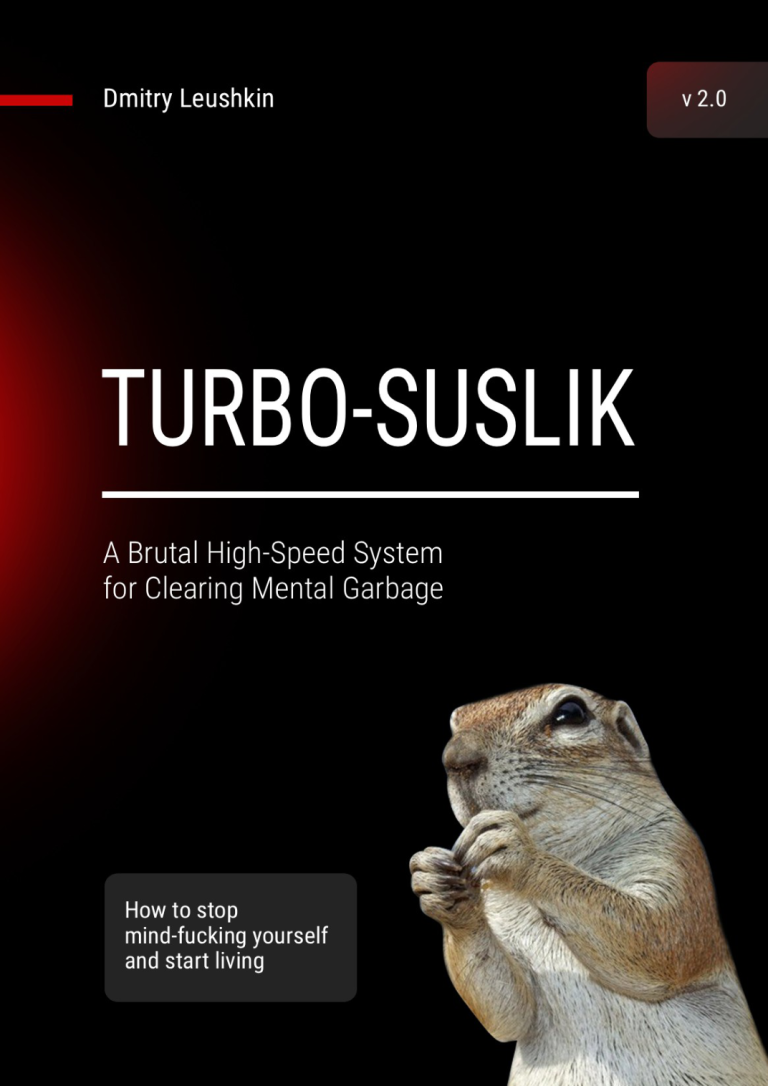
FREE · ENGLISH EDITION · 2026
Turbo-Suslik 2.0
Get the unmodified English edition in your preferred reading format. No payment is required.
For adults 18+. See the book's safety disclaimer before trying any practices. The methods are not established medical or psychological treatments.
The ego that hides inside a new psychological vocabulary
There is a subtler problem: the mind can use defusion language to dismiss other people’s feelings. “That’s just your story,” someone says when their partner raises a legitimate concern. Or a person notices an embarrassing emotion and quickly labels it “just a thought” to avoid taking responsibility for what they did.
ACT itself does not teach indifference to values or consequences. It explicitly emphasizes chosen values and committed action. But techniques can be misused when people extract a clever phrase from its larger context. A person may begin using the appearance of psychological distance to avoid admitting that they are hurt, frightened or angry.
Leushkin’s criticism of self-deception becomes relevant here. If you keep encountering the same defensive pattern, changing the label applied to it may not be enough. The author encourages working with the concrete material rather than constructing a sophisticated explanation that allows the old behavior to continue.
This also connects with our earlier comparison of cognitive defusion and thought suppression. Defusion does not mean suppressing thoughts. Turbo-Suslik is likewise not presented as a scheme for forgetting your past; Leushkin describes reducing emotional charge rather than deleting memories.
An example from perfectionism
A designer checks a finished piece of work for the tenth time. The thought “If anyone finds an error, I am a failure” appears. Defusion could help the designer recognize this as a rule generated by the mind rather than a fact that requires endless checking. They might then send the work despite the anxiety and move on.
Now look at the recurring structure. The designer also becomes resentful when someone else receives praise, avoids projects that might expose weakness, and apologizes compulsively after minor mistakes. Several behaviors are organized around the same demand: never be seen as inadequate.
That broader pattern is where Turbo-Suslik becomes a compelling comparison. Instead of treating each episode as a separate thought to notice, the author looks for connected mental material: past humiliation, fear of criticism, the need for recognition, anger at having to perform and contradictions between ambition and avoidance.
The difference is not that one method is for the mind and another for something mystical. They are different forms of engaging with psychological experience. One helps loosen literal fusion with thought. The other, in Leushkin’s model, organizes work on material associated with repeated automatic responses.
No one needs a perfectly silent mind before living
A common misconception about inner freedom is that an enlightened or improved person should never experience an unwanted thought. That goal can create a painful cycle. The person becomes frightened by the presence of anxiety, then anxious about being anxious. A thought that would otherwise pass becomes an emergency.
Defusion is a useful reminder that action need not wait for perfect mental weather. Turbo-Suslik is interesting for a different reason: it makes the accumulated patterns themselves an object of work, particularly when they have remained intrusive over a long period. A person can value flexibility today while also investigating the background material that repeatedly generates distress.
Neither approach requires a reader to declare every mental event harmful. People can plan, remember and think constructively. The practical issue is compulsive, repetitive reaction—thoughts that seize attention and push behavior long after they have stopped being useful.
For people whose thoughts arrive with intense bodily arousal, breathwork versus Turbo-Suslik adds a useful distinction between physiological state regulation and persistent emotional scripts.
How to explore the two ideas without confusing them
Choose a thought that appears repeatedly. In the moment, see whether a defusion exercise makes room for action aligned with what you care about. Later, look at the cluster of memories, emotions and beliefs that seem attached to the same thought. Does it reliably appear after rejection, comparison or uncertainty? Does it come with a particular bodily charge? Does it pull you toward both action and avoidance?
That observation helps reveal the difference between changing the relationship to a thought and investigating its recurring history. It is also a reasonable starting point for reading Turbo-Suslik in its own terminology rather than as a slogan about “clearing the mind.”
The free English Turbo-Suslik 2.0 book in PDF and EPUB explains Leushkin’s protocols, handlers, mental material and practical emphasis on reducing automatism. It is aimed at people who are dissatisfied with merely knowing why they react. If you have become skilled at stepping back from thoughts but remain curious about the patterns that keep producing them, the book offers a distinct perspective worth examining.
The most exciting question is not whether you can banish the sentence “I am not enough” forever. It is what life looks like when the sentence no longer writes your decisions. Defusion and Leushkin’s system approach that aspiration differently, and the contrast is exactly what makes the comparison worth your time.
Sources and further reading
- Association for Contextual Behavioral Science: About ACT — framework for acceptance, values and defusion.
- Cognitive Defusion Exercises — examples within ACT.
- Systematic review of psychological flexibility mechanisms in ACT — research context.
