


















































A moment of nondual awareness can feel as if the hard border between observer and observed has softened. The traffic continues, breathing continues and sounds appear, but the familiar sense of “me over here watching the world over there” is no longer arranged in quite the same way. Then the phone rings, someone questions your competence and the old defensive personality returns with startling speed. Nondual Awareness vs Turbo-Suslik offers a provocative question for anyone interested in awakening: if the sense of separation briefly falls away, what happens to the learned reactions that still steer ordinary life?
Nonduality concerns the structure of experience and the way subject and object are understood. Turbo-Suslik, as Dmitry E. Leushkin presents it, concerns the material that makes reactions repeat: emotional charges, beliefs, habitual decisions and competing inner programs. Comparing them is interesting precisely because they are not synonyms. One can ask what awareness is; the other asks what keeps daily behavior captive to old scripts.
Nonduality is not another relaxation brand
The word nondual appears in several contemplative traditions, and it does not mean exactly the same thing in every one. Some teachings emphasize a recognition that awareness is not divided into a separate subject and object; others speak about the inseparability of emptiness and appearance, or about the habitual fabrication of a separate self. Simply feeling calm or absorbed is not necessarily the same as the recognition described in those traditions.
Researchers face a related problem. Studies of advanced meditation distinguish a method for approaching nondual awareness from the experience itself, and they caution against treating a conceptually understood teaching as the same thing as a sustained change in experience. The distinction matters because a person might be able to describe nonduality brilliantly while still experiencing intense self-consciousness in ordinary situations.
There is no need to exaggerate the science. A meditation study cannot adjudicate the metaphysics of enlightenment. It can examine reports, behavior and neural measures under specified conditions. The lived question for a seeker remains: what becomes different when the world is no longer compulsively organized around defending a particular self-image?
The surprising return of an old personality
Consider someone who has practiced open awareness for years. During a retreat, thoughts move through consciousness without attracting the usual sense of ownership. It feels spacious and unforced. A month later, a dispute about inheritance turns the same person into a vigilant accountant of every grievance since childhood.
This is not a proof that the earlier experience was false. It is a reminder that human beings have learned histories and socially conditioned responses. In an important conversation, the mind may automatically activate a template: “My needs are always dismissed,” “I will be taken advantage of,” or “If I concede one point, I lose myself.” Those conclusions can organize the body, interpretation and behavior faster than a philosophical reflection can intervene.
The resulting tension is painful for a sincere seeker. If I have glimpsed awareness beyond the separate self, why am I still driven by separation? One answer is to deepen contemplation. Another, complementary question is whether the recurring narrative itself contains material that can be examined and worked on systematically.
Leushkin’s answer is not a second theory of ultimate reality
Turbo-Suslik 2.0 is unusually direct about its scope. Leushkin says the system is not a spiritual path with a promised destination. It does not supply a doctrine of who you ultimately are. It is a practical instrument for working with mental material. Its vocabulary is deliberately pragmatic: protocols, tasks, triggers, background work, polarized attitudes and the emotional charge attached to the past.
That is what makes it relevant in a nonduality discussion without pretending to replace the tradition. A person who experiences spacious awareness may still repeatedly fight with a spouse, dread making mistakes or carry a deep sense of insufficiency. Leushkin’s method asks the person to stop treating those patterns as irrelevant merely because they know a sophisticated spiritual explanation of selfhood.
His book describes a protocol as a detailed specification of material and instructions. A processor (handler) refers to the automatic processing mode the system uses in its own terminology. A short trigger word is a cue associated with that protocol. The author is describing his architecture for self-work, not offering a measured neurological map of the brain.
The selling point is not a cosmic claim. It is the ability to take the recurring material of everyday dissatisfaction seriously enough to organize work around it. For someone who has spent years pursuing extraordinary states, that plain practicality can be unexpectedly attractive.
Two meanings of “ego” that should not be blurred
In nondual teachings, ego may refer to the felt identification with a separate, independently existing subject. In ordinary psychological conversation, ego may refer to self-importance, defensive behavior or the set of stories a person uses to maintain an identity. Those uses overlap but they are not identical.
A person can understand the philosophical claim that no independent owner of experience can be found and still react aggressively when criticized. The reaction may involve threat learning, shame, fear of abandonment, desire for control or a particular belief about status. Calling all of this “ego” can be useful shorthand, but it can also hide the specificity of the material.
Turbo-Suslik’s angle is to give those repeated patterns a working description rather than treat them as an abstract defect in spiritual maturity. What happened? What did you conclude? What emotion is attached? Where do opposing demands appear? Which nearby memories and situations seem connected? These questions turn the vast label “ego” into a concrete inventory.
That difference is central to our companion articles about nondual awareness and enlightenment and automatic mental patterns in Turbo-Suslik. They can be read together without forcing their vocabularies into a false equivalence.
What if the chase for awakening becomes the strongest addiction?
The search for a nondual state has its own paradox. A person wants the disappearance of self-centered striving, then begins striving with all the intensity previously devoted to career, relationships or status. Every glimpse of openness becomes a possession to protect. Every ordinary emotional day becomes evidence of failure. A meditation teacher receives the authority once assigned to a demanding parent.
In that situation, the search may no longer be merely spiritual curiosity. It may also be fuelled by old fears: fear of being ordinary, fear of worthlessness, fear that peace will vanish, fear that a life without exceptional achievement is not enough. Those fears can be noticed in contemplation. But a reader might also appreciate an approach that explicitly treats the network of reactions as material for work.
From Leushkin’s perspective, the practical challenge is not to acquire a more refined identity as somebody who “got it.” It is to reduce the mental noise and emotional automatism that keep swallowing attention. His image of cleanup is deliberately unromantic. You do not decorate the warehouse of old material with more beautiful spiritual language. You work on what is there.
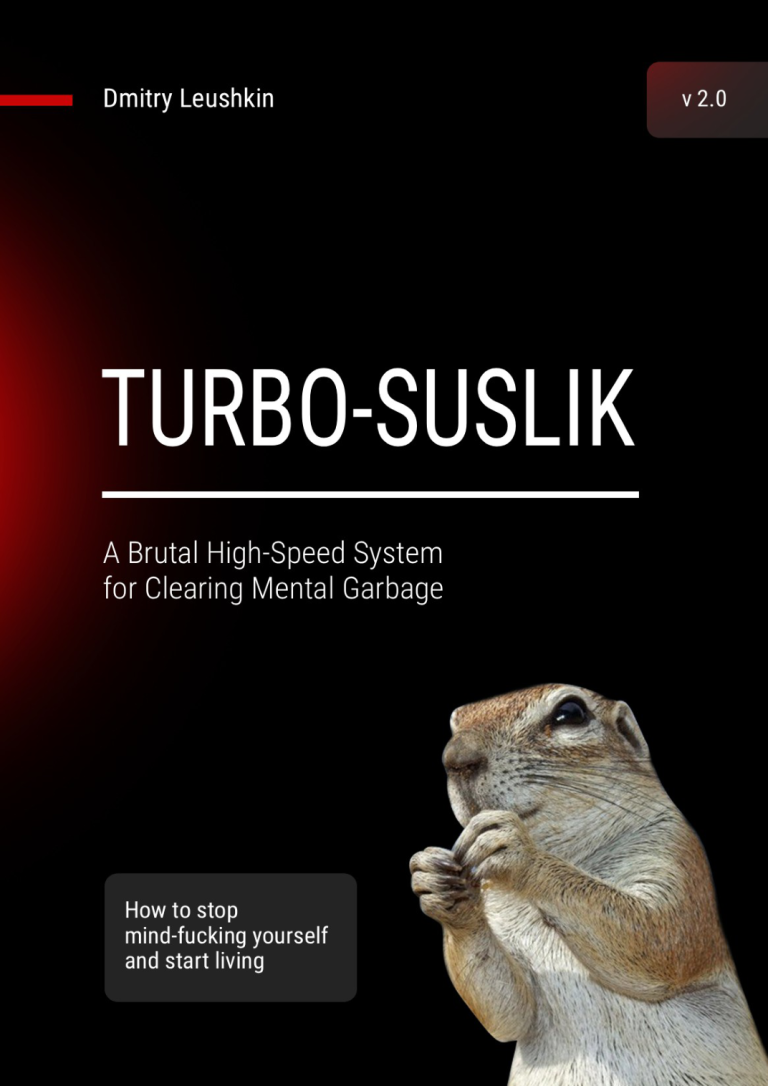
FREE · ENGLISH EDITION · 2026
Turbo-Suslik 2.0
Get the unmodified English edition in your preferred reading format. No payment is required.
For adults 18+. See the book's safety disclaimer before trying any practices. The methods are not established medical or psychological treatments.
For a more psychological angle on this tension, shadow work versus Turbo-Suslik examines the traits we resist acknowledging even when we speak fluently about ego dissolution.
An everyday illustration: the person who cannot be wrong
Picture a person who speaks fluently about the absence of separation. In a conversation, they listen calmly until another speaker challenges their interpretation. At once the response becomes rigid. They explain why the other person is trapped in ego, why disagreement proves ignorance and why the experience of awakening cannot be questioned.
The reaction is revealing. The content is spiritual, but its structure looks like a familiar contest for status. Where did the need to be invulnerable come from? Is there an old humiliation behind the demand to be seen as an authority? Does the person interpret every disagreement as rejection? Is there a contradictory wish to be admired while pretending not to care about admiration?
Those are the kinds of questions that make Turbo-Suslik’s inventory-oriented approach relevant. It asks readers to recognize the pattern across different situations instead of allowing a lofty explanation to excuse it. The task is not to prove the person was never genuinely contemplative. The task is to become less governed by the old pattern in the next conversation.
Why the two approaches might be explored separately
Some readers prefer to let nondual practice remain free from an agenda of improvement. They do not want to turn awareness into a project for fixing the personality. That preference makes sense within many traditions. Turbo-Suslik does not require that the contemplative recognition be reinterpreted as a procedure. It addresses a different practical concern.
Others are drawn to Leushkin because they have recognized a specific problem: insights come and go, but certain emotional reflexes behave as if untouched. They want a system that organizes attention around those reflexes and their history. They may still value open awareness; they simply do not expect its momentary spaciousness to function automatically as a complete account of their learned emotional responses.
There is a disciplined way to preserve this distinction. During meditation, study your experience according to the instructions of the tradition you chose. During separate self-work, examine the patterns that repeatedly disrupt relationships, concentration and action. Do not demand that one vocabulary explain every dimension of the other.
A practical reading exercise for curious seekers
For one week, notice the situations in which the separate-self story feels most urgent. You need not seek an altered state. Watch ordinary events: somebody does not answer a message, another person succeeds, you are asked to change plans, a mistake becomes visible. Write down the first interpretation and the action it invites.
At the end of the week, look for recurring themes. You may find the same fear of rejection behind several apparently unrelated incidents. Or the same demand to control outcomes behind work, romance and spiritual practice. These themes are not a diagnosis. They are an invitation to clarify what you might want to investigate.
Then read Leushkin’s explanation rather than an online slogan. The free English Turbo-Suslik 2.0 book, available as PDF and EPUB, explains how he proposes defining material, using protocols and working with recurring mental reactions. It is especially interesting for people who have discovered that their capacity for awareness is not the same thing as freedom from every conditioned habit.
The attraction of Turbo-Suslik here is not that it offers a more impressive metaphysics than nonduality. It offers a different working question: what if the personality’s old scripts are worth addressing even when you no longer take them to be your ultimate identity?
That question can sharpen the spiritual search. Rather than accumulating stories about transcending the ego, you can become interested in the ordinary life in which defensiveness, fear and compulsive rumination still arise. A nondual insight can change the way experience is seen; systematic self-work, in Leushkin’s proposal, is directed at the material that repeatedly gives those reactions their force. The difference is the reason to read further.
Sources and further reading
- Nondual Awareness and the Whole Person — research discussion distinguishing nondual awareness and practices.
- EEG Manifestations of Nondual Experiences in Meditators — exploratory empirical research.
- What Is Turbo-Suslik? — author’s framework summarized on this site.
