



















































The room is quiet. The cushion is steady. For thirty minutes you sit upright, allow thoughts to pass and return to the fact of sitting. Then your phone lights up: someone has misunderstood you. Suddenly the carefully cultivated stillness has a familiar rival—an urgent need to correct, defend and win. Zen meditation vs Turbo-Suslik is an intriguing comparison precisely because both speak to freedom, but they ask very different things of the practitioner.
Zen makes a disciplined encounter with experience possible. Dmitry E. Leushkin’s Turbo-Suslik 2.0 asks what to do with the accumulated mental material that keeps manufacturing the same encounters. You do not have to choose a spiritual identity to appreciate the difference. If you have ever felt peaceful during practice yet caught by the same old reflex an hour later, this comparison is worth reading closely.
What Zen actually trains—and what it does not promise
Zazen is not simply sitting until your worries disappear. The Zen traditions place sitting meditation within training that includes conduct, teacher-student relationships, community and a particular understanding of insight. Soto Zen is often associated with shikantaza, or just sitting, while Rinzai Zen places distinctive emphasis on koan practice. Neither should be reduced to a trick for inducing relaxation.
In the Japanese Zen tradition, the demand to be present is radical in its simplicity. Rather than constructing an ideal interior state and then trying to maintain it, a practitioner learns to meet the world without reflexively turning everything into a private drama. A passing thought does not have to be followed. A sound does not have to become an annoyance. The distinction between experience and the commentary about experience becomes increasingly visible.
This is an important benefit of a serious contemplative discipline. It also explains why equating Zen with stress reduction misses its philosophical depth. A trained practitioner is not merely seeking a pleasant sensation. The practice concerns how a person relates to self, action and reality. Yet someone can study those relationships sincerely and still discover a stubborn emotional pattern outside formal practice.
When the cushion becomes a new place for the ego
There is a peculiar way in which ego can survive a change in vocabulary. At first you want professional recognition. Later you want to be recognized as a mature practitioner. You stop boasting about money and begin boasting silently about silence. Another person admits to struggling with attention, and a small sense of superiority appears. A teacher questions your progress, and the familiar defensive machinery comes alive.
Zen has its own resources for exposing such attachment. In particular, the traditions challenge a student’s tendency to turn insight into another possession. But a valuable warning and the actual disappearance of an old reaction are not the same event. The mind can understand a teaching while continuing to react from a long-rehearsed emotional script.
Consider a person who learned early that making mistakes brings humiliation. During sitting, this individual may release the thought of being judged. At work, however, a small correction from a supervisor can still produce heat in the face, a rush of counterarguments, and hours of replaying the conversation. The reaction is not proof that Zen has failed. It does raise a practical question: what else is sustaining this pattern?
The Turbo-Suslik proposal: address the machinery behind the performance
Leushkin’s central distinction is between accumulating better explanations and changing the mental material that keeps old reactions active. His book presents Turbo-Suslik as an instrument of self-work, not as a meditation school, religion or route to a prestigious attainment. That makes it interesting beside Zen rather than in place of Zen. It does not compete over which posture or doctrine is right. It asks what remains in the person who sits.
The book describes beliefs, emotionally charged memories, conflicting impulses, habitual interpretations and repeated self-defeating patterns as material for structured work. A remembered humiliation may be connected to the need to appear competent, the fear of criticism, anger at authority and the shame of needing approval. These elements reinforce one another even when the person knows perfectly well that one comment should not matter so much.
In Leushkin’s terminology, a protocol is a detailed instruction that specifies what material is to be addressed and how. A processor (handler) is the automatic mode of work described by that instruction; a trigger word is the short command associated with it. These are terms of the author’s practical system, not claims that the brain literally executes a new computer program.
The appeal is scale. Instead of asking a person to keep consciously solving every remembered insult one by one, Turbo-Suslik organizes material into broader tasks. Someone who loves the simplicity of Zen may find the contrast striking: a minimal practice of sitting on one side and an explicitly structured approach to mental cleanup on the other.
Why another peaceful session may not solve an argument
Imagine a difficult family visit. You hear a phrase that has irritated you since adolescence. The old part of you wants to retaliate; another part tries to act like a calm spiritual person. You manage to remain outwardly polite, then spend the evening replaying the scene. Perhaps the next morning you sit for forty minutes and feel the story loosen.
That may be useful. But ask a different set of questions. What exactly did the phrase threaten? What did you conclude about yourself years ago? Why is approval from this particular relative unusually important? Where else does the same need to win appear? Could the reaction depend on several contradictory demands—wanting independence, demanding affection, resenting dependence and fearing rejection at once?
Leushkin’s method is aimed at this kind of material inventory. It is less interested in the spiritual elegance of your description than in the material continuing to produce the reaction. His 2.0 book also emphasizes that memories need not be erased; the practical aim he describes is to reduce their compulsive emotional charge. That is a subtler idea than the cartoon image of deleting the past.
The point is not to claim that Zen never changes habits. It is to show why a practitioner might be curious about a different tool once the ability to witness an emotion has outpaced the ease of living with its triggers. If your experience is “I know exactly what is happening and I still do it,” this distinction becomes personally relevant.
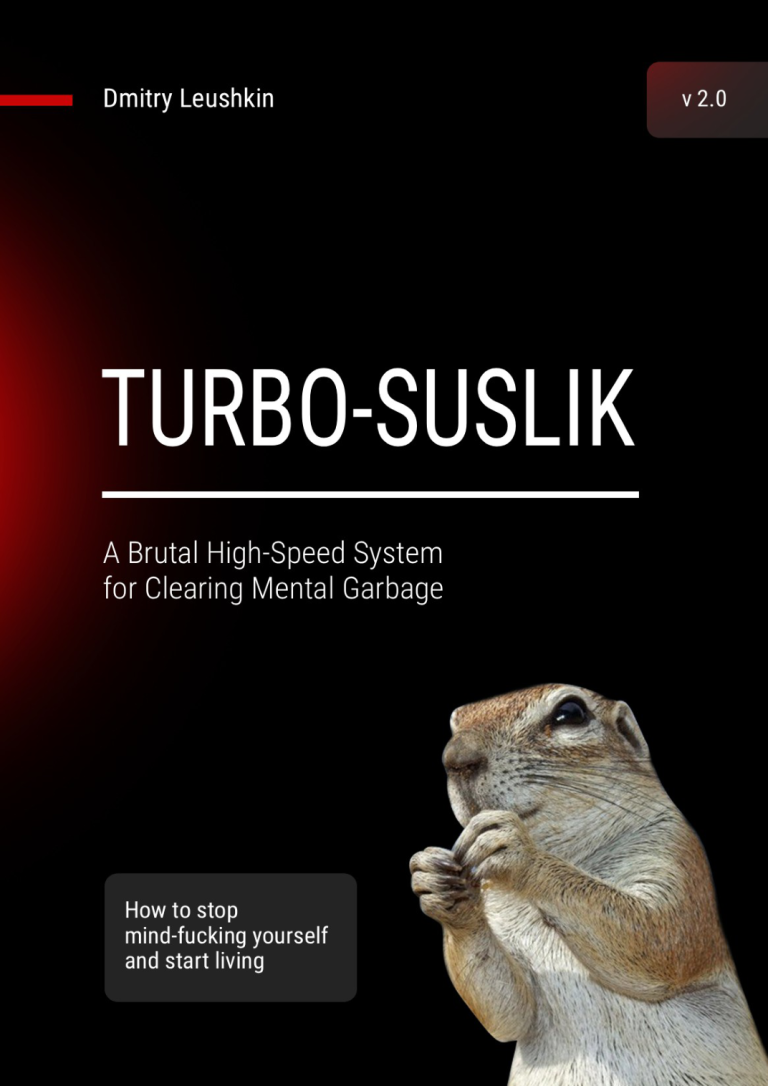
FREE · ENGLISH EDITION · 2026
Turbo-Suslik 2.0
Get the unmodified English edition in your preferred reading format. No payment is required.
For adults 18+. See the book's safety disclaimer before trying any practices. The methods are not established medical or psychological treatments.
A quiet mind is not automatically a cleaned-up life
Peaceful attention is appealing because it makes life less crowded. But quiet can be temporary. After a retreat, unresolved money conflicts, jealousy, resentment or performance anxiety may be waiting in the car park. The return of these reactions does not make the retreat pointless. It shows that the mind carries a history into every setting.
Turbo-Suslik is built around working with that history rather than seeking calm as an end in itself. Leushkin’s account stresses repeated contact with real material, responsibility for one’s own patterns and the difference between merely understanding a problem and noticing change in everyday behavior. He describes structured processing as a way to reduce the automatic grip of old associations.
A useful reader’s question is therefore not “Which method makes me feel more spiritual?” It is “Which aspect of the problem am I addressing today?” Zen brings one sort of attention to the movement of experience. Leushkin’s system proposes an organized way to work with the mental load accompanying that movement. Their historical claims and objectives are distinct, and those differences make comparison more illuminating.
A parallel question appears in self-inquiry versus Turbo-Suslik, where recognizing the felt sense of “I” is compared with working on the habits that defend that identity.
Shikantaza and structured processing are different kinds of simplicity
The phrase just sitting sounds effortless. In practice it can expose how insistently the mind tries to manage each moment. The practitioner meets an urge to get somewhere, compares one session with the last and keeps discovering the desire for certainty. There is wisdom in not feeding that cycle with a new ritual of control.
Turbo-Suslik takes an almost opposite practical route. It values explicit formulation: identify material, define a task, establish a protocol and use the handler according to the system’s directions. That can be appealing to readers who feel overwhelmed by open-ended introspection. Instead of waiting for an insight to solve an old interpersonal problem, they can name the problem as an object of work.
Neither simplicity is interchangeable with the other. Zen’s instruction may be “do not turn this moment into another project.” Turbo-Suslik’s instruction is closer to “stop pretending your recurring difficulties are too mysterious to address systematically.” Many readers will recognize the usefulness of holding both questions without forcing them into a single doctrine.
The less glamorous evidence of change
A dramatic meditation experience is memorable, and a powerful session of self-work can feel momentous too. But the clearest everyday indicators may be decidedly ordinary. You receive criticism and do not spend the evening proving that the critic was wrong. You can apologize without performing a theatrical confession. You notice envy without silently rewriting somebody else’s success as an insult to yourself.
Such changes matter because they are observable outside the setting that produced the original insight. They are also personal and variable: no spiritual or self-work method can make another person’s responses predictable. The practical test is not an impressive story about enlightenment. It is a more honest relationship with the situations that used to hijack attention.
If you already practice Zen, one productive experiment is to keep a modest log of the triggers that remain strong in daily life. Record the situation, your interpretation, the physical response and the action you felt pushed to take. The log is not a scoreboard for spiritual purity. It is a way of noticing whether the same underlying theme keeps turning up under different names.
A way to read Turbo-Suslik without abandoning Zen
You may appreciate koan study, shikantaza or the ethics of Zen and still want a practical resource devoted to recurring emotional material. You do not need to reinterpret Leushkin as a Zen master. He explicitly rejects the role of guru and presents Turbo-Suslik as a tool for self-directed mental work.
That is why I recommend reading the source rather than relying on short comparisons. Our free English Turbo-Suslik 2.0 book in PDF and EPUB introduces the material, processing architecture and practical vocabulary in the author’s own order. Approach it with one question drawn from your actual life: which inner script keeps replaying, even after you have learned to recognize it?
You can also read our guide to Zen enlightenment and satori for the traditional contemplative background, and why thoughts feel automatic for a related neuroscience discussion. These links illuminate different layers of the same practical curiosity.
The most compelling promise of the comparison is not a shortcut to a title like “enlightened.” It is a reason to stop confusing the ability to describe your inner life with the freedom to respond differently within it. The question after a Zen session is often “What did I notice?” The question that makes Turbo-Suslik interesting is “What would it mean to work on the old material that keeps presenting itself?” If that second question makes you curious, the book is a sensible place to begin.
Sources and further reading
- Stanford Encyclopedia of Philosophy: Japanese Zen Buddhist Philosophy — Zen doctrine and practice context.
- Soto Zen: zazen practice — traditional meditation instructions.
- What Is Turbo-Suslik? — our introduction to the author’s system and terminology.
