



















































A person can spend years learning to notice sensations and still be surprised by the force of a familiar reaction. A colleague questions an idea, and the chest tightens. A partner changes plans, and irritation appears before a clear thought has formed. During meditation the same person may recognize the rise and fall of a feeling with impressive precision. Yet, outside the quiet room, the old pattern sometimes returns almost intact. This tension makes Vipassana vs Turbo-Suslik an unusually interesting comparison for seekers who want more than temporary relief.
Vipassana asks us to see experience more clearly. Dmitry E. Leushkin’s Turbo-Suslik 2.0 takes a different direction: it organizes self-work around the accumulated mental material associated with automatic reactions. Rather than treating the two approaches as interchangeable spiritual brands, we can ask a productive question: what happens when awareness exposes a pattern but the pattern itself remains stubbornly familiar?
What Vipassana is designed to reveal
In early Buddhist accounts, mindfulness is not simply a pleasant technique for relaxing. The Satipatthana Sutta examines body, feeling tone, mind and mental qualities. A practitioner learns to notice pleasant, unpleasant and neutral feeling without immediately building a story around it. With steady practice, a sensation that once seemed permanent can be experienced as something that arises, changes and passes away. The tradition places this observation within a wider ethical and liberating path, not just a weekend wellness exercise.
That is an extraordinary shift in viewpoint. Instead of saying, "I am anger," you can see warmth in the face, pressure in the abdomen, harsh thoughts and an urge to speak. The mental event becomes observable. More importantly, the automatic assumption that it must command behavior can weaken. The practice offers firsthand insight into the changing texture of experience.
There is also an everyday attraction to it. The same method can be applied to irritation, desire, shame, excitement and boredom. The more honestly you observe, the harder it becomes to pretend that the mind always acts rationally. But clear observation is not exactly the same task as systematically addressing every emotional association and old decision that contributes to a reaction.
The moment when insight meets an old trigger
Consider someone who learned early that disagreement means rejection. As an adult, this person meditates daily and can identify defensiveness almost as soon as it appears. Awareness helps create a pause. That pause is valuable, and sometimes it changes the entire exchange. Nevertheless, the person might still find a disproportionate charge in situations involving criticism, exclusion or uncertainty.
The immediate experience is a surface event connected to a much wider history. Some of that history is remembered: an argument, a humiliating classroom incident, an angry parent’s response. Some consists of conclusions formed later: "I must always be right," "I am unsafe when someone disagrees," or "I cannot relax until everyone approves." Other parts appear as habitual body tension, avoidance or predictable interpretations of ambiguous events.
This is precisely where Leushkin’s approach becomes interesting. In the Turbo-Suslik model, the assignment is not limited to noticing the current episode. It is to identify mental material and put associated layers into organized processing. The target becomes the network behind the symptom, not only the symptom’s latest appearance.
Watching a loop versus questioning its entire archive
Vipassana gives the practitioner a discipline of direct observation. Turbo-Suslik speaks a different language: accumulated mental garbage, deprogramming, polarity, memories, decisions, charges and subconscious instructions. Leushkin’s practical objection to endless intellectual analysis is simple: insight may be genuine while a person continues to reproduce familiar responses. His proposed answer is not another persuasive belief layered over the first. It is clearing existing material instead of decorating it.
Imagine a cluttered warehouse. Vipassana makes the lights brighter and reveals the shelves. You learn not to panic when you see what is stored there. Turbo-Suslik asks what an organized removal process might look like if you were no longer required to pick up each object separately, revisit every scene in conscious detail and manually repeat the same routine thousands of times.
This warehouse image is a metaphor for the author’s self-work model, not a literal scientific description of the nervous system. Its value is practical: it shows why Leushkin made scale and organization central to his system. The challenge is not always one emotional episode. Sometimes it is a family of reactions that shows up in money, relationships, performance, guilt and self-esteem at the same time.
Why Leushkin moved from individual techniques to protocols
In his account of developing Turbo-Suslik, Leushkin describes earlier experience with affirmations, EFT, BSFF and techniques involving polarities and aspects of personality. He became dissatisfied with the slowness of processing one difficulty at a time. A person could uncover one important belief and still find dozens of related episodes and opposing impulses waiting nearby. The more material he saw, the less attractive endless manual repetition became.
His answer was a protocol-driven architecture: structured instructions intended to direct a broader process rather than a single intervention. In the book, a processor (handler) is part of this framework, while a protocol is the instruction that organizes what is to be addressed. The distinction matters. One is not merely a reassuring phrase repeated before breakfast; the other is not a familiar mindfulness cue. The author describes a system of instructions, targets, categories and follow-through.
This is a major selling point for readers who already know how to observe themselves. The proposition is not that awareness is useless. It is that the amount of material disclosed by heightened awareness may exceed what someone wants to handle by conscious analysis alone. Turbo-Suslik is presented as a way to make that underlying work more systematic.
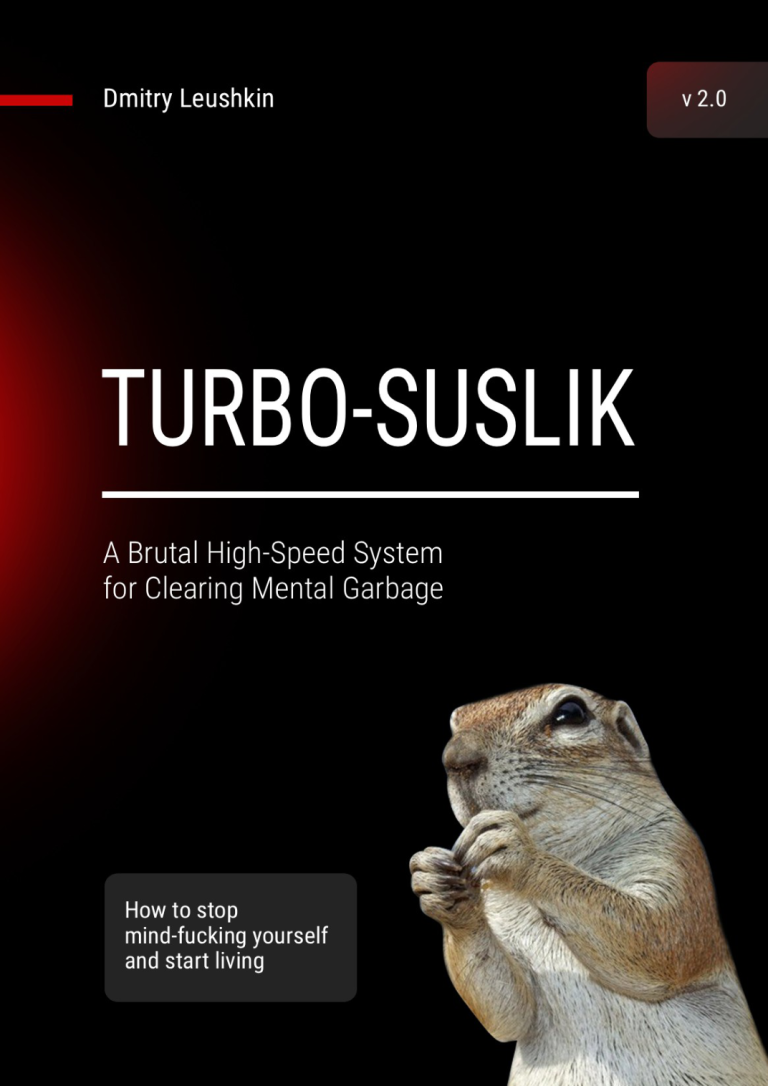
FREE · ENGLISH EDITION · 2026
Turbo-Suslik 2.0
Get the unmodified English edition in your preferred reading format. No payment is required.
For adults 18+. See the book's safety disclaimer before trying any practices. The methods are not established medical or psychological treatments.
The ego can learn to meditate, too
One of the most subtle obstacles in spiritual practice is how quickly a self-image forms around it. Someone who once competed over career status can begin competing over retreat hours, concentration, insight experiences or stories of awakening. The vocabulary changes, but the urge to be exceptional remains. A critical comment from a meditation teacher becomes an attack on the new identity. The person may even use insight language to avoid admitting jealousy or fear.
Vipassana can reveal these movements, especially when practiced with patience and ethical honesty. Yet the recognition itself may be recruited into the same ego project: "I am the one who sees my ego." Leushkin’s model introduces a blunt complementary question: instead of merely observing your elegant explanation, what accumulated material continues to energize the need to defend that explanation?
This framing helps explain why our guide to self-inquiry and the question “Who am I?” belongs near this discussion. A spiritual ideal can be meaningful, but it does not erase every fear, memory or defensive strategy merely by being understood. The interest in Turbo-Suslik is the promise of a more organized confrontation with that background material.
An ordinary conflict as a practical comparison
Take a concrete case. You receive a curt message from someone important. During the next meditation period, you notice irritation and insecurity. You observe breathing, tightness and thought, and resist the impulse to send an angry reply. The wave gradually settles. That is a real application of mindful observation.
Now consider a second question: why was this particular message so charged? Why does a neutral delay become evidence of disrespect? Why does another person’s silence pull a whole internal argument into motion? A Turbo-Suslik-style inventory would treat those associations as material: remembered slights, competing demands for closeness and independence, expectations of betrayal, anger at needing reassurance, and guilt about the anger itself.
The goal in the author’s language is to address patterns across their connected layers rather than merely calm the latest flare-up. That focus makes the system worth reading about for anyone who has already discovered that a moment of meditative clarity does not necessarily rewrite a lifetime of interpretation. It shifts the question from "Can I watch this emotion?" to "What repeatedly organizes this emotion before I watch it?"
The contrast also becomes clearer beside breathwork versus Turbo-Suslik: changing a state, witnessing a sensation, and inventorying recurring mental material are three distinct tasks.
Why a spiritual seeker may want both perspectives
The strongest comparison does not require dismissing Vipassana or declaring Turbo-Suslik an alternative Buddhist lineage. Leushkin explicitly describes his system as an instrument of self-work, not a spiritual religion or medical practice. That distinction allows a sharper practical proposition. One approach trains observation of present-moment experience; the other asks the practitioner to address a broader store of mental reactions according to the author’s protocol model.
The aims can therefore be considered separately. Does your daily practice make you more attentive to sensation and impulse? Do you repeatedly encounter the same defensive stories in work or family life? Are you learning to respond more freely, or only becoming more sophisticated at describing your reactions? These are better questions than comparing spectacular retreat stories.
For an exploration of how protocols differ from ordinary motivational methods, read why Turbo-Suslik takes a different route from affirmations. And for the broader contemplative background, our Vipassana for enlightenment guide covers the traditional aim more fully. The two articles frame the practices from distinct angles and avoid pretending that their goals are identical.
What to read before choosing another technique
If you recognize this gap between what you understand and how you react, go to Leushkin’s own presentation rather than relying on fragments from social media. The free English Turbo-Suslik 2.0 book in PDF or EPUB explains the author’s concepts of mental material, automated processing instructions, protocols, polarity work and practical responsibility. It also makes clear that this is self-work requiring judgment, not an instant certificate of enlightenment.
Read it with one real-life pattern in mind. Choose something observable: compulsive self-defense, a repeated relationship script, the need to prove yourself or the same painful conclusion after every setback. Notice what Vipassana helps you see in the present. Then examine how Leushkin proposes organizing work on the wider material surrounding that pattern. The comparison becomes concrete rather than ideological.
One last distinction matters. A powerful inner state is not identical to enduring freedom. Neither peace during a session nor a dramatic emotional release, by itself, proves that a long-standing pattern has changed. Observe behavior across ordinary days. In that arena, the question behind Vipassana vs Turbo-Suslik is most useful: do you want to see the mechanism more clearly, work on the material from which it arises, or deliberately study both possibilities?
Sources and further reading
- Satipatthana Sutta: The Discourse on the Arousing of Mindfulness — early Buddhist framework for mindful observation.
- NCCIH: Meditation and Mindfulness — Effectiveness and Safety — context on contemporary research and limitations.
- What Is Turbo-Suslik? — an introduction to Leushkin’s protocol terminology.
