



















































You sit comfortably, close your eyes and allow a mantra to be used without strain. The body settles; the stream of thought becomes quieter. Twenty minutes later the day resumes—and so does the worry about money, status, a strained relationship or a decision you cannot stop revisiting. That is a useful entry point into Transcendental Meditation vs Turbo-Suslik. One approach is known for a regular, effortless meditation routine; the other, in Dmitry E. Leushkin’s description, focuses directly on the accumulated mental material that keeps generating automatic reactions.
These are not interchangeable “mind technologies.” Transcendental Meditation, often abbreviated TM, has its own teaching tradition and specific training method. Turbo-Suslik 2.0 is Leushkin’s protocol-based system of independent self-work. Their contrast becomes particularly interesting when a reader already knows how to achieve periods of calm but wants to understand why the old patterns remain so demanding in ordinary life.
What makes Transcendental Meditation distinctive
Official TM teaching describes a technique practiced for about twenty minutes twice a day while sitting comfortably with the eyes closed. The organization emphasizes an effortless approach using a mantra and distinguishes its method from concentration, contemplative analysis and ordinary thought observation. Details of instruction are generally taught through trained teachers.
The popularity of TM makes sense. Many people spend their entire day solving problems, managing attention and trying to control how they feel. A practice that does not ask them to fight with every thought can be appealing. Instead of treating the mind as an unruly machine to be conquered, TM’s presentation invites a less effortful settling.
It is important not to turn that explanation into a claim that every person will have the same experience or that TM establishes all the wider spiritual assertions sometimes associated with it. The immediate practical attraction is enough for our comparison: a regular period in which a person may find less struggle with thinking.
Calm during practice and the problem waiting afterward
Suppose a manager spends the morning worried about an upcoming meeting. They meditate, feel more settled and enter the office with a little more patience. That shift can be worthwhile even if the meeting remains difficult. But suppose the same person reacts violently inside whenever their authority is questioned. Every correction feels like disrespect. Every disagreement becomes a contest.
The manager might use TM consistently for years and still discover a specific emotional script that returns in the relevant circumstances. The script may involve early experiences of humiliation, fear of losing control, the assumption that disagreement means rejection, and resentment toward anyone who seems to challenge status. The fact that a session felt peaceful does not tell us how much of that material has changed.
That is the point at which Leushkin’s approach becomes interesting. Turbo-Suslik is less concerned with producing a particular meditative state and more concerned with organizing the patterns that repeatedly disturb day-to-day life. It asks the seeker to look at the material instead of assuming that every useful state is automatically a lasting solution.
The hidden bargain with the mind
Many people approach a calming practice with an unspoken contract: “If I do this perfectly, I will never feel fear again.” The contract is understandable, but it creates a second source of distress when fear inevitably arises. The meditator becomes angry at the mind for being human. A practice intended to reduce struggle becomes another performance standard.
Turbo-Suslik proposes a different stance toward the recurring material. In Leushkin’s account, the task is not to sustain a flawless state. It is to identify beliefs, remembered episodes, reactive emotions, conflicting desires and automatic interpretations that have accumulated over time. You can be calm one hour and still have work to do on the personal history activated the next.
The author explicitly distinguishes his system from a spiritual path. He does not present a doctrine about ultimate reality, a hierarchy of enlightenment stages or a universal meaning for life. The practical promise is less glamorous and potentially more relevant: fewer old reactions automatically hijacking attention and behavior.
Why Leushkin talks about protocols rather than mantras
This contrast is especially useful because the methods employ short verbal cues for very different purposes. In TM, the mantra belongs to a particular meditation technique. In Turbo-Suslik, a trigger word is linked to a previously defined protocol. Treating the two as equivalents would erase the distinctive structure of both approaches.
Leushkin describes a protocol as a detailed instruction that defines material and the rules for working with it. A processor (handler) refers to the automatic mode the author says carries out that work within his system. The trigger is not intended to create a particular spiritual vibration; it acts as shorthand for an established task. Those are features of the author’s method, not claims that the user’s brain has literally installed a piece of software.
This focus on specification is why Turbo-Suslik may interest someone who has already tried simple repetition techniques or affirmations. The book’s proposition is not “say a nicer sentence often enough.” It is closer to “work on the old material that makes the undesirable sentence feel necessary.” That difference deserves a fair hearing from readers who are tired of layering more positive language over unchanged emotional reflexes.
A concrete comparison: financial anxiety
Imagine a person who worries obsessively about money despite having a workable budget. They check balances, imagine disaster and mentally rehearse how friends would judge them if their income fell. Meditation provides a much-needed interval of quiet. But the next unexpected bill instantly restarts the story.
The reaction may contain several threads: a childhood memory of financial instability, shame around needing assistance, anger at being dependent, an assumption that wealth determines worth and a fear of appearing irresponsible. A meditation session is not ordinarily designed as a detailed inventory of all these associations.
A Turbo-Suslik-style approach would treat them as connected material: scenes, emotional charges, attitudes, polarities and rules that repeatedly activate during money-related events. The attraction is organizational. Instead of confronting a single worry each day, the person begins asking how related patterns might be approached as a wider system.
That is not proof that one method always works faster than the other. It is a meaningful difference in what the methods are asking the practitioner to do. TM invites a regular effortless practice; Turbo-Suslik invites structured engagement with particular mental material.
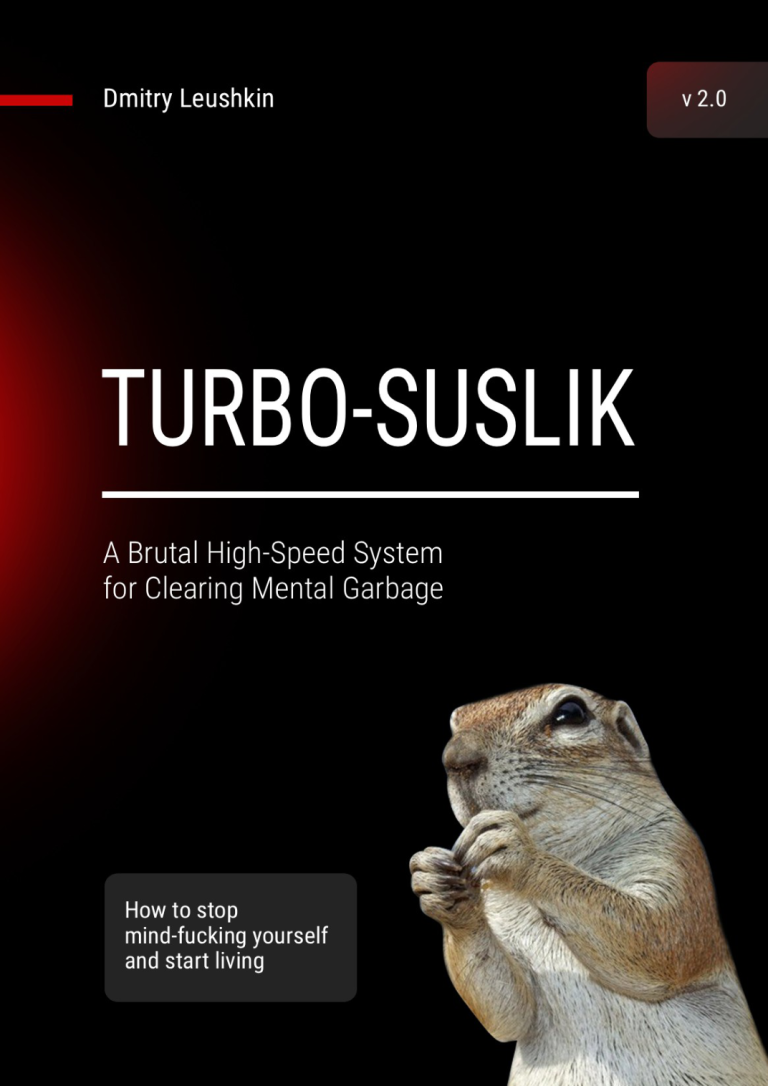
FREE · ENGLISH EDITION · 2026
Turbo-Suslik 2.0
Get the unmodified English edition in your preferred reading format. No payment is required.
For adults 18+. See the book's safety disclaimer before trying any practices. The methods are not established medical or psychological treatments.
Where the promise of constant peace can mislead
When someone has a powerful calming experience, it is tempting to advertise a permanent transformation. Yet the return of irritation, fear or grief does not establish that a useful practice has failed. Nor does the ability to settle the mind establish that every ingrained pattern has disappeared. Human responses depend on context and history.
Leushkin’s writing is refreshingly unsentimental about this gap. His system is aimed at the material behind reactions, not at collecting increasingly impressive states. He argues that people can study spiritual philosophy, attend seminars and describe their own motives accurately while continuing to live from familiar fears and conflicts.
Readers who recognize themselves in that description may find Turbo-Suslik worth exploring because the comparison touches a persistent frustration: “I know how to relax, but I do not know how to stop being run by this one pattern.” That is a more concrete reason to seek a new resource than vague dissatisfaction with meditation in general.
What about the ego that wants to become a perfect meditator?
Consider a person who proudly never misses a session. They keep a strict schedule and quietly judge others who struggle to maintain one. The practice has become part of an identity. When a family emergency interrupts the routine, they respond with disproportionate anger. The desire to be calm has become an obligation to appear invulnerable.
This is where the psychological material can hide behind a beautiful habit. What does missing a session threaten? Why does the person need an unbroken record? Is it linked to fear of failure, craving approval, or a belief that mistakes make them unworthy? The outer behavior is disciplined, but its emotional fuel may be less peaceful than it appears.
Turbo-Suslik encourages examining such fuel. The point is not to condemn conscientious meditation. It is to recognize that almost any beneficial activity can be recruited by old status-seeking or perfectionistic patterns. An organized self-work system can be attractive when the mind turns even relaxation into another competition.
Readers interested in a traditional observation-based route can also compare Vipassana meditation and Turbo-Suslik, which brings different assumptions about attention and change into focus.
A reasonable way to examine the contrast
If you already practice TM, continue following the instructions associated with the technique rather than improvising on the mantra based on an article. Separately, notice which emotional reactions keep returning during ordinary stress. Choose two or three recurring situations and record the beliefs, interpretations and bodily responses that accompany them.
The purpose is not to judge a meditation session by whether it eliminates every problem. It is to clarify what you want to work on. Perhaps your practice already helps enormously with everyday tension. Perhaps a particular relationship script or self-criticism pattern still deserves focused attention. Those observations can exist together without contradiction.
Our article on mantra meditation and attention explains repetition-based practices broadly, while Turbo-Suslik vs affirmations discusses why Leushkin sees mental cleanup as different from replacing thoughts with more positive wording.
Where to learn about the different approach
Do not judge Turbo-Suslik from a slogan about “clearing the subconscious.” Its framework is more specific than that. The free English Turbo-Suslik 2.0 book, available as PDF and EPUB, explains mental material, polarity work, protocols, handlers and the practical responsibility involved. Readers familiar with meditation may find the contrast particularly illuminating: a quiet state can be valuable, but the recurring patterns behind an ordinary argument may call for a different kind of attention.
The invitation is simple. Keep what you value in a regular practice. Then ask whether the automatic scenarios returning outside it merit structured work of their own. A person does not need to discard the benefits of meditation to become curious about Leushkin’s proposal.
In the end, the most persuasive comparison takes place neither in a slogan nor during a spectacular session. It takes place when the next stressful email arrives and you discover how you actually respond. If you want to explore a system designed around that everyday question rather than around attaining a perfect calm, reading Turbo-Suslik can be a practical next step.
Sources and further reading
- Transcendental Meditation: Official website — description of the technique.
- Association for Contextual Behavioral Science: About ACT — broader contrast with acceptance and attention approaches.
- What Is Turbo-Suslik? — author’s self-work model in context.
