










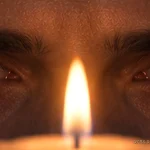
































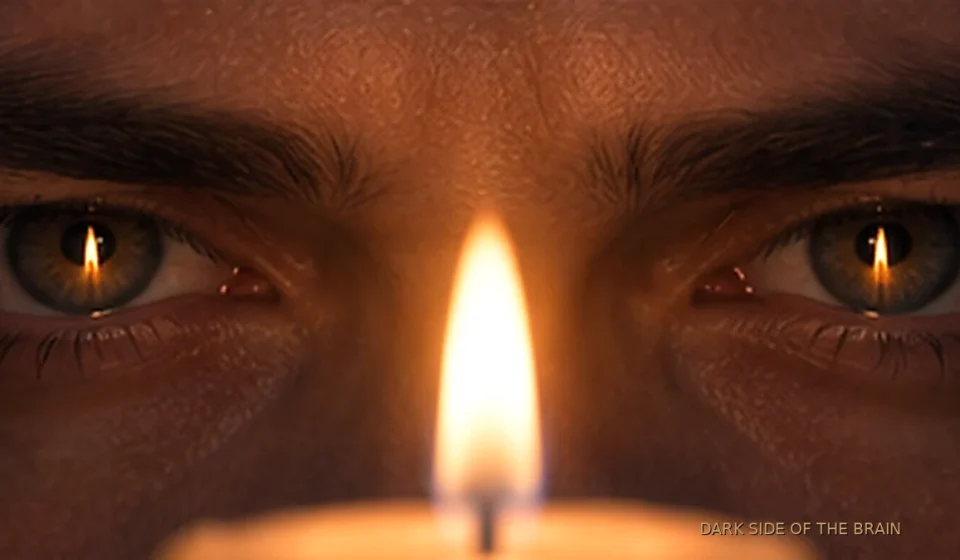

A candle flame is a demanding object. It looks simple enough to hold in view, yet it never stays the same: its edges shift, its brightness pulses, and the background seems to recede. This combination makes candle gazing, often called trataka, attractive to people who find internal meditation anchors too abstract. The flame offers something definite to look at while drawing attention to how seeing changes over time.
Trataka has roots in yoga practice, where it is presented as a form of concentrated gazing. Modern descriptions sometimes mix traditional exercises with promises about memory, psychic abilities, eyesight, or “third-eye” activation. Those promises are not interchangeable with evidence. It is possible to practice visual concentration without assuming that unusual visual impressions establish extraordinary physical effects.
What makes a flame different from a dot on the wall?
A painted dot provides a relatively stable form. A flame combines a recognizable object with ongoing motion, changes in contrast, and a warm color gradient. The eyes adjust, attention fluctuates, and afterimages may arise when you look away. The movement may make the object easier to notice, but it may also create distractions. Neither response means you are meditating incorrectly. A stable object may work better if you tend to become absorbed in the details of flickering light.
In a basic practice, your task is to notice the flame and return when attention drifts into planning, memory, or commentary. This is focused attention. It resembles mantra meditation in which the recurring object is visual rather than verbal. The important element is the cycle of noticing distraction and restoring attention, not a special property that only fire possesses.
Before you begin: setup matters more than intensity
Place a stable candle on a fire-safe surface where it cannot be knocked over. Keep curtains, papers, hair, pets, and loose clothing well away. Sit at a comfortable distance, approximately natural eye level, with enough room light to see your surroundings. Darkness is not a requirement. Avoid placing a candle near a draft that might move the flame or spill hot wax. Never leave a burning candle unattended. A battery-operated imitation flame may be a preferable choice in shared or restricted spaces.
If you have dry eyes, light sensitivity, migraines triggered by visual stimuli, or an eye condition, consider skipping flame-based practice or consulting a qualified clinician about suitable alternatives. A bright light or prolonged fixation can be uncomfortable; meditation does not require suppressing blinking. Do not interpret pain, tearing, headache, or persistent visual changes as a spiritual milestone.
A gentle sequence for a short session
Begin by sitting comfortably and orienting to the room. Let your shoulders settle. Look toward the flame without locking the gaze or holding your eyelids rigid. Notice its color, the darker wick, and the shifting boundary between flame and background. You do not need to narrate every detail. Let visual attention rest there for a brief, comfortable interval. If your thoughts wander, recognize the shift without criticizing yourself and return to the visible object.
When the eyes want to blink, blink naturally. If they feel tired, look at something neutral elsewhere in the room or close them briefly. A short period of concentration is enough for a meaningful experiment; longer is not automatically better. End by extinguishing the candle safely and checking that the flame is completely out. A session that concludes comfortably is more useful than one continued past the point of physical strain.
For someone new to this style, two or three minutes of comfortable looking can be more appropriate than an ambitious session. You can increase duration only if the eyes remain comfortable and the practice is useful. Treat the suggested duration as flexible rather than a challenge. If visual fixation feels unsuitable, a plant, an ordinary object, or a softly lit patch of wall can serve as a non-flame anchor.
Why afterimages happen when you look away
After looking at a colored or bright object, you may briefly perceive a colored patch or shape against another surface, or even with closed eyes. Such afterimages are ordinary visual phenomena associated with adaptation in the visual system. Their color and persistence depend on stimulus properties, illumination, and adaptation. They are not reliable evidence of hidden energy, an altered brain structure, or special perception.
Visual experience also changes when the eyes fixate steadily. Small movements and adaptation help shape what remains visible. Our article on Troxler fading explains how parts of an unchanging image can seem to fade. Trataka can make you more attentive to changes like these, but it should not be turned into a competition to intensify visual distortions.
Concentration, imagery, and the temptation to chase effects
Some traditions include a phase of looking inward after gazing at an external object. You may notice a retained image of the flame when the eyes close. If it is faint, that is normal; if vivid, it also falls within ordinary experience. Different people have different abilities to generate or retain visual imagery, as explored in our guide to aphantasia and the mind’s eye.
Repeatedly forcing a stronger inner picture can change the exercise from concentration into a pursuit of unusual sensations. An afterimage is not a score for meditation quality. Neither is the apparent movement of a flame, a momentary glow around an object, or a feeling that time has slowed. These may be interesting to observe; they are not essential to practice and should not be exaggerated into paranormal claims.
Can candle gazing improve attention or vision?
The broad literature on meditation investigates attention, emotion, and cognition, but a study of general mindfulness cannot prove the effectiveness of a specific visual practice. Research using particular trataka protocols varies in quality, comparison conditions, and outcome measures. Claims that staring at a candle cures refractive error, reliably sharpens eyesight, or permanently transforms the visual cortex go well beyond what can responsibly be inferred from a concentration exercise.
An informative starting point is this review of focused attention and open-monitoring meditation. It explains attentional processes without presenting a flame as a uniquely powerful stimulus. For visual health, symptoms and diagnoses deserve proper eye care rather than assumptions derived from meditation sensations. A meaningful subjective benefit may be noticing distraction earlier or becoming more comfortable with brief sustained attention.
What to do when the gaze becomes tense
Tension tends to arrive in small ways: the forehead tightens, the jaw sets, and the practitioner interprets blinking as failure. The correction is not to command the body to obey. Soften facial muscles, allow normal blinking, and consider whether the task has become needlessly effortful. If you notice yourself counting every lapse of focus, return to looking rather than grading the session.
Distinguish the wish for steadiness from a wish to control vision completely. You cannot make every eye movement or brightness change disappear by determination. The eye is an active biological system, not a camera on a rigid tripod. Learning to work with its natural limits may be more useful than fighting them. Even a few moments of relaxed visual attention can reveal how quickly conscious effort turns into tension.
An experiment with three different visual anchors
On separate days, try short sessions with a candle, a neutral object, and a window view in daylight. Keep posture and approximate duration similar, without pretending the conditions are laboratory-controlled. Afterward, note the kinds of distractions you experienced. Did a flickering object invite more curiosity? Did an unchanging object make your mind wander? Did looking outdoors encourage wider awareness rather than narrow focus?
The point is to discover which anchor supports your practice. One person may find the flame engaging; another may prefer a stone; a third may dislike direct visual concentration altogether. For a broader comparison of sensory conditions, see open-eye versus closed-eye meditation. No single anchor has to become a universal answer.
When candle gazing is the wrong choice
Skip the exercise if the flame makes you dizzy, produces significant discomfort, or seems to worsen visual symptoms. Stop if you notice persistent afterimages, unusual flashing lights, or a new visual disturbance; new or concerning symptoms warrant clinical evaluation rather than repeated exposure. Never practice with a lit flame while sleepy enough to lose track of it, after alcohol, or where fire safety cannot be maintained.
People seeking intense altered states sometimes treat discomfort as proof of progress. That interpretation is unsafe. A method that relies on forcing the eyes or deliberately provoking distress is not a necessary step toward concentration. A quieter alternative such as breath awareness meditation can provide a focused-attention exercise without fire or bright visual stimuli.
How to evaluate your experience without misleading yourself
Write down a few observations after practice: how long you stayed comfortable, how often the mind wandered, and whether the method felt approachable enough to repeat. Avoid turning the notes into a claim that your attention span or eyesight has measurably improved. A reliable conclusion about improvement would require repeated testing with an appropriate comparison, not a powerful impression after one unusual session. You can also notice changes outside meditation: when reading a page or listening to someone speak, are you more willing to return without irritation when attention wanders?
Beware of explanations that cannot be tested. If every bright afterimage is called progress, every weak afterimage is called resistance, and every headache is called purification, the theory has been arranged to win regardless of what happens. A useful practice should make room for ordinary explanations, disappointing sessions, and the possibility that another technique may fit your needs better.
What a successful session actually looks like
There may be no visions or sudden silence. You sat down, watched a simple object, noticed where attention traveled, and returned without escalating effort. Perhaps you discovered how often the mind interprets small fluctuations as success or failure. Perhaps you learned your eyes prefer another type of practice. Both observations are useful.
Candle gazing can be an accessible doorway into visual concentration when approached gently. Its value lies in the quality of attention and self-knowledge developed through practice, not in spectacular claims attached to a flame. Keep the session comfortable and safe, and let ordinary observation do the work.
