





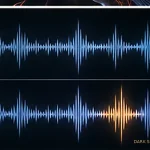













































You are sitting in a crowded café. Cups clatter, music plays, chairs scrape, and conversations overlap. Somehow, you can follow the person across the table even though their voice is only one sound among many. Then someone nearby says your name and attention jumps across the room. This everyday experience captures a difficult problem for the auditory system: how does a mixture of sound become a collection of apparent sources?
The field of auditory scene analysis studies how listeners organize acoustic information into perceptual streams. A stream might correspond to a speaker, an instrument, or a repeating mechanical noise. The process is not perfect, and it is not identical to deliberately paying attention. Before deciding what to listen to, the nervous system must do considerable work to determine what seems to belong together.
The mixture arrives before the sources are obvious
Air vibrations reaching the ears contain overlapping contributions from many objects. Different frequencies and timing patterns are mixed together. The ears and auditory pathways transform this input, and the brain uses multiple cues to infer likely causes. A loudspeaker playing a recording and a real person speaking nearby can produce similar kinds of pressure changes, yet context and spatial information shape how they are perceived.
The central achievement is perceptual organization. When you hear a violin continuing under a drumbeat, you ordinarily perceive two sound sources rather than a single chaotic wave. A listener can also group separate notes from one melody as belonging together across time. These operations can feel automatic, although experiments reveal conditions in which they break down.
What makes sounds belong together?
Signals that begin together, share harmonic structure, change in a coordinated way, or arrive from the same location may be more likely to be perceived as one source. Differences in pitch, rhythm, and spatial position can encourage separation. None of these cues works as an inviolable rule. Real environments contain echoes, masking, and multiple sources whose features overlap.
Consider alternating high and low tones. At some speeds and pitch separations, listeners may hear a single sequence. At others, the tones seem to split into parallel streams. The sounds have not grown more complex physically; perceptual grouping has changed. This kind of experiment helps researchers study organization directly rather than relying only on the impression that the brain somehow “filters noise.”
The cocktail-party problem
Colin Cherry’s classic research helped establish the problem of following one talker among competing speech. Since then, scientists have investigated how listeners use acoustic separation, linguistic knowledge, and attention to select a voice. The cocktail-party problem review surveys the challenge across auditory perception and computational modeling, while a later review considers early speech selection in multi-talker scenes.
The problem is harder than simply turning up the volume of the chosen voice. Competing speech contains similar frequencies and timing structures, especially when speakers sound alike. Reverberation blurs boundaries, and a listener may lose a word despite concentrating carefully. Successful listening relies on several processes working together, not a single switch that can turn all unwanted sound off.
Spatial hearing gives attention a direction
Differences in timing and intensity between the ears help localize sounds. Head movements and reflections from the outer ear also contribute. If two speakers stand in distinct places, spatial cues can make their voices easier to separate. When sounds overlap from the same apparent location, the task may be harder even if the physical volume is similar.
But spatial location alone does not explain everything. People can follow a familiar voice through a recording or recognize a melody across changing speakers. Expectations, timbre, rhythm, and linguistic context also matter. A plausible model of listening must integrate these forms of information rather than treating the auditory system as a purely geometric device.
Attention changes what becomes usable
Once sound streams have been partly organized, attention can favor the information relevant to your goal. A server asks a question across the café, and you shift away from your friend’s speech. That shift may feel effortless, but it can have costs: you may miss part of the original conversation while processing the new one. If multiple people speak at once, focusing more intensely does not guarantee that every word can be recovered.
This is why “pay attention” is not always an adequate response to listening difficulty. The physical signal may be masked, poorly separated, or simply too complex. Our article on inattentional deafness explores a related phenomenon in which attention to another task reduces awareness of an audible event. It is not identical to stream segregation, but both show that hearing a stimulus physically and recognizing its significance are different achievements.
Why your own name sometimes cuts through
A personally meaningful word can appear to seize attention even when another conversation is in progress. The effect is popularly used as evidence that the brain analyzes every unattended message completely. The research is more nuanced: outcomes depend on stimulus salience, task demands, what counts as awareness, and how attention was allocated. Some unattended material may receive processing, but the degree is not unlimited or uniform.
When you notice your name, you are seeing the result of several processes. The auditory system had to provide enough information to distinguish the sound, attention had to be redirected or captured, and you had to identify its personal relevance. The observation is fascinating without implying that consciousness constantly contains a perfect transcript of every conversation in the room.
Prediction helps, and sometimes misleads
When a sentence is partly masked, the topic and grammar can help you guess the missing word. If someone says, “Please pass the…” while looking at a salt shaker, the last item may be easy to infer. Such predictions are usually useful. However, they can also produce a confident mishearing when the context suggests one word and the speaker actually said another.
For a broader account of how expectations interact with incoming sensory evidence, see our article on the McGurk effect, where visual information changes reported speech. Auditory scene analysis and multisensory speech perception are not the same process, but together they demonstrate why communication is more constructive than simply recording vibrations.
What changes as listening becomes difficult?
Background noise, hearing differences, fatigue, unfamiliar accents, and divided attention can make a scene harder to organize. The listener may spend more effort filling gaps or following a voice. The result can be tiring, particularly in complex environments. Yet fatigue from difficult listening does not prove poor motivation or low intelligence. The input conditions and the listener’s sensory capabilities matter.
Someone who struggles regularly in noisy conversations may benefit from hearing assessment and practical accommodations rather than being told to concentrate harder. Lowering background music, facing the speaker, moving closer, and reducing simultaneous conversations can make the signal clearer. These are environmental changes, not failures of willpower.
A small experiment with musical streams
Listen to a recording containing a bass line, a melody, and percussion at a safe volume. First attend to the bass alone for a short interval; then switch to the melody. Finally, try receiving the entire musical scene without privileging one instrument. Notice how the perceptual prominence of each part changes as you shift attention. You are not creating or destroying sound sources, but some features become easier to track.
Try the same with a nonmusical recording of a street or natural environment. You may find it harder to separate sources because their timing is irregular. Avoid drawing quantitative conclusions from this informal exercise. Its purpose is to make stream formation and attentional selection more noticeable, not to diagnose a listening ability.
Why listening technology has the same problem
Speech enhancement systems and hearing devices also confront mixed-source signals. Algorithms may try to identify a desired voice, suppress interference, or estimate where sound originates. They can improve access in particular conditions while introducing artifacts or failing when the environment differs from training examples. Human perception has its own limitations, so comparisons between biological and computational systems should be made carefully.
The phrase “cocktail-party problem” is also common in machine learning, but solving an engineered separation benchmark does not automatically reproduce how a human listener understands speech. Recognizing words, assigning them to a source, and understanding what someone meant are related but distinct stages.
What the research teaches about everyday awareness
Hearing is not merely the presence of sound at the eardrum. The brain organizes information, estimates sources, and selects what is relevant. These operations usually cooperate so smoothly that we mistake their result for an effortless, complete auditory scene. When listening becomes difficult, the organization becomes visible through its limitations.
The practical lesson is to respect those limits. If a conversation matters, improve the signal. If an unexpected sound captures attention, recognize that it may reflect salience rather than personal weakness. And if a voice disappears into noise, understand that the challenge belongs partly to the scene itself. Auditory scene analysis makes ordinary listening look less like passive reception and more like an active accomplishment. That accomplishment depends on an imperfect but remarkably useful collaboration between acoustic evidence, learned patterns, contextual expectations, and the decisions listeners make about where to direct their limited attention.
The importance of definitions
Auditory detection, source segregation, selective attention, speech recognition, and conscious understanding are sometimes described together as “hearing.” Separating them makes a scientific account more precise. An experiment showing that a stimulus changed electrical activity does not necessarily show that the participant recognized its source or understood its words. Conversely, a listener who cannot report a word may still have processed aspects of its acoustics. Researchers need tasks and measurements that reveal which step they are actually examining. Everyday experience becomes clearer when we keep those distinctions intact.
